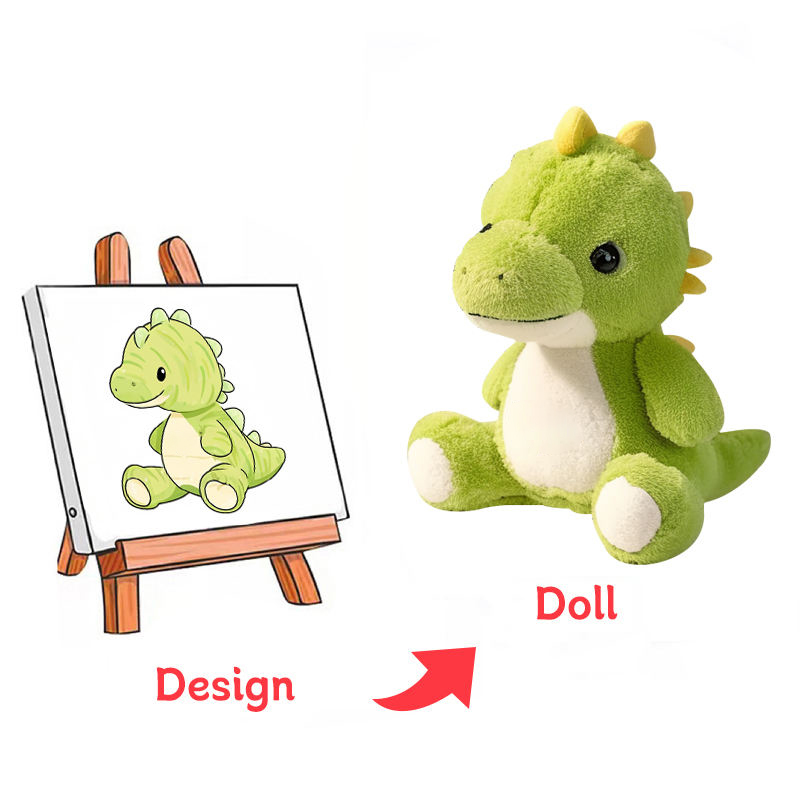

1. The Core Engineering Decision in Custom Anime & Character Plush Development
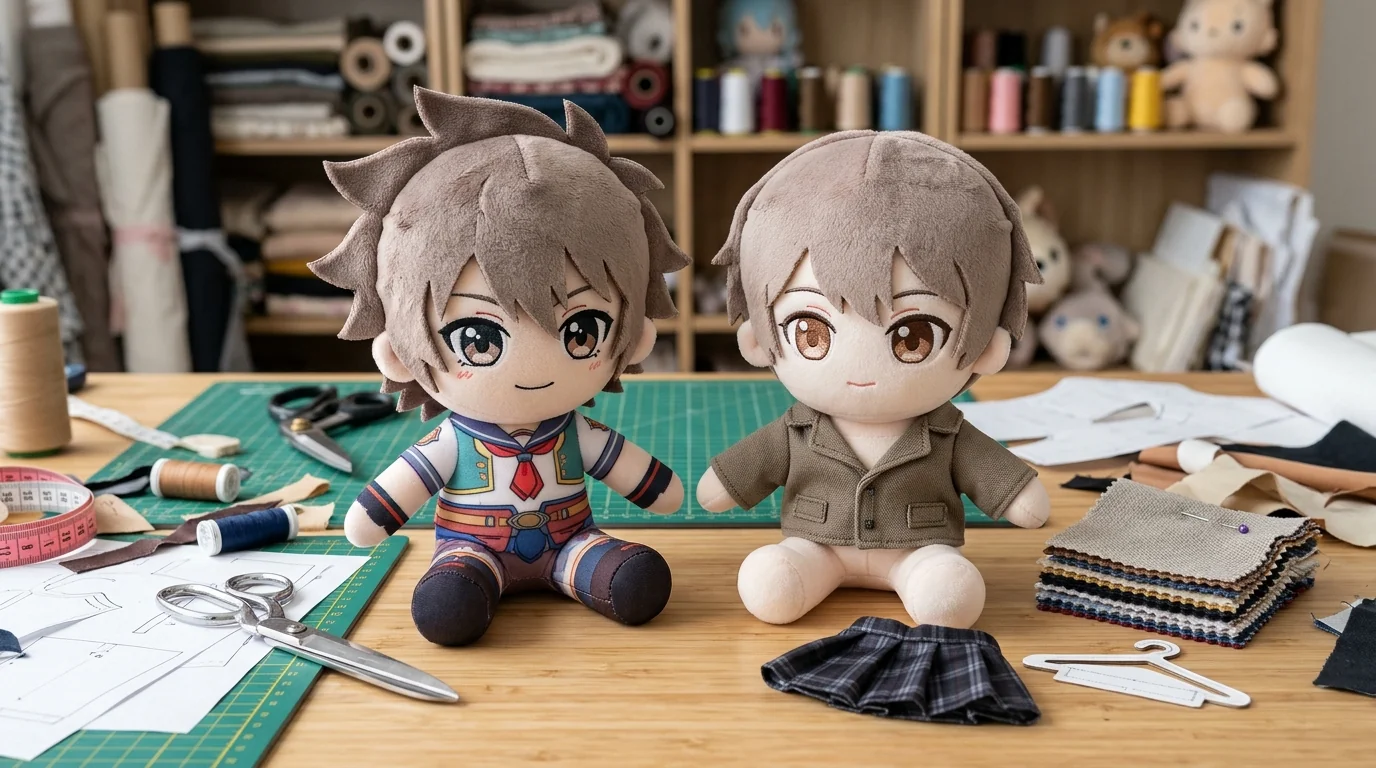
Unlike traditional woodland stuffed animals that use a single uniform fur fabric across the entire body, humanoid characters from animation, video games, VTuber streams, and comic IP require complex multi-material construction. When planning a line with a custom anime plush toys OEM manufacturer, product managers face two defining structural choices right at the tech-pack stage: how to engineer three-dimensional layered hairstyles, and whether the character’s outfit should be permanently integrated into the torso or tailored as removable dress-up garments.
Choosing between anime plush sewn-in clothing and anime plush removable clothing design directly impacts your unit manufacturing cost by 25% to 60%, alters your minimum order sizing, and changes how fans interact with the product. A promo-priced arcade prize plush and a premium $35 collector ‘nui’ dress-up doll follow completely different pattern-making rules.
2. Should Anime Plush Clothing Be Sewn-In or Removable? (Cost, Play Value & Durability)
For IP owners and merchandise buyers asking should anime plush clothing be sewn in or removable, the decision requires weighing interactive collector value against assembly labor and child-safety compliance:
| Comparison Dimension | Sewn-In / Integrated Clothing | Semi-Integrated (Tack-Stitched Layer) | Fully Removable Dress-Up Clothing |
|---|---|---|---|
| Construction Logic | Torso panels ARE the outfit (dyed or sublimated fabric sewn directly as the body shell) | Separate jacket/cape sewn over a basic body and tack-stitched down at shoulders/hem | Complete standalone base doll body + separately tailored miniature garments with closures |
| Relative Unit Cost Impact | Baseline (1.0× cost) — fastest sewing cycle | Moderate (+15% to +25% cost) — adds 3D depth without closure hardware | Premium (+35% to +65% cost) — essentially manufacturing a doll PLUS miniature apparel |
| Visual Fit & Silhouette | Sleek, tight, zero bunching; ideal for complex armor or gradients | Good layered depth; outfit never rides up or gets lost during shipping | Slightly looser tailoring required so hands/feet can pass through sleeves |
| Child Safety (0+ vs 3+/14+) | Highest safety: zero detachable small parts or choking hazards | High safety when tack stitches pass 90N (21 lbs) tension testing | Requires micro-Velcro/snaps; small accessories often graded for Ages 3+ or 14+ collectors |
| Best Commercial Use Case | 10–15 cm bag charms, convention giveaways, standard retail SKUs | 15–25 cm hero retail plush needing 3D collars, capes, or belts | 20 cm collector ‘dress-up nui’ dolls + standalone accessory outfit booster packs |
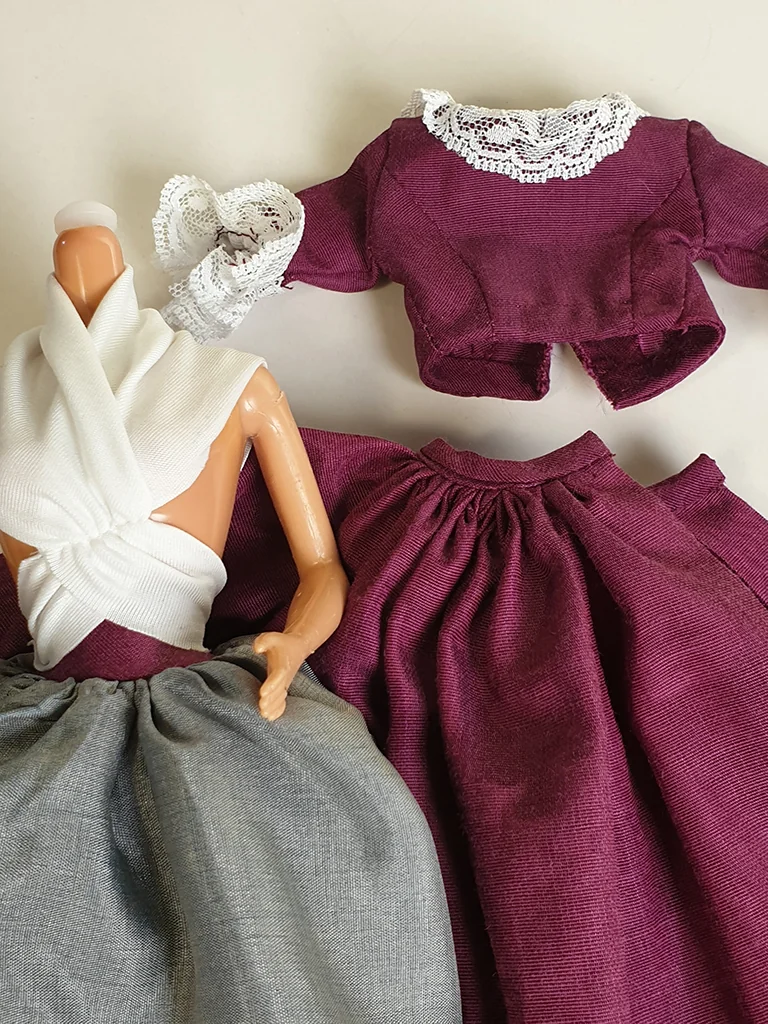
As the real miniature garment example above demonstrates, removable plush accessories require genuine apparel engineering: every tiny sleeve cuff, collar facing, and skirt hem must be overlocked or turned-and-topstitched so the inside of the garment does not fray when fans dress and undress the doll.
3. How Does Plush Toy Size Affect Removable Clothing Design?
When buyers ask how does plush toy size affect removable clothing design, physical seam allowance geometry sets a hard lower boundary: **inside a miniature sleeve, a standard 4 mm overlock seam occupies the exact same space whether the doll is 10 cm or 30 cm tall**.
- Under 12 cm (Keychains & Mini Plush — Use Sewn-In or One-Piece Cape): On a 10 cm mini plush, an arm is only 12 mm wide. Attempting to sew a multi-piece removable shirt with sleeves and Velcro results in stiff, bulky seams that cannot be turned right-side-out. For
- 15 cm to 20 cm (The ‘Cotton Doll’ Collector Standard — Ideal for Dress-Up): In the global anime collector market, 15 cm and 20 cm sitting/standing plush bodies are the gold standard for removable outfits. At 20 cm, torso and limb circumference is large enough to accommodate soft baby-grade micro hook-and-loop tape (Velcro), elastic waistbands, ribbed knit collars, and miniature metal snaps.
- 25 cm to 40 cm+ (Large Display Plush — Full Multi-Layer Tailoring): Larger plush mascots easily support multi-piece removable uniforms, hoodies with working drawcords/zippers, pleated skirts, and structured PU-leather boots.
For compact impulse items such as custom mini plush toys and keychain charms, OEM engineers strongly recommend dye-sublimation printing on short tricot/velboa for intricate armor or uniform details, paired with a single removable poncho, hood, or scarf if interactive play value is desired.
4. Engineering Custom Character Plush Hair Structure: Spikes, Bangs, and Volume
Anime and gaming characters are famous for gravity-defying hairstyles—layered bangs, twin tails, ahoge hair spikes, and two-tone color gradients. Building a durable custom character plush hair structure during custom plush development and pattern translation relies on three distinct textile constructions:
1. **Double-Sided Laminated Minky with Foam Interfacing (‘Sandwich Hair’)**: Two layers of 1.5 mm crystal velboa or mochi minky are heat-laminated onto a thin 1.5 mm–2.0 mm polyurethane foam or stiff non-woven interfacing core, then laser-cut or satin-edged into sharp anime bangs and side locks. This prevents raw fabric edges from fraying while keeping hair spikes upright without sagging.
2. **3D Stuffed Hair Gussets (Pony-Tails, Buns & Chibi Locks)**: For thick twin-tails or rounded chibi hair volumes, pattern makers draft hollow 3D fabric gussets lightly stuffed with 1.2D fiberfill and quilted with directional embroidery lines.
3. **Sublimated Gradient Hair Panels**: When a character’s hair transitions from dark navy at the crown to neon cyan at the tips, high-resolution dye-sublimation printing is applied to white short-pile velboa panels before laser cutting.
5. What Should Buyers Check When Approving Anime Plush Hair and Outfits?
Before signing off on your Golden Sample, audit your prototype against four specialized anime plush garment construction checks: First, **Velcro Snag Protection**: ordinary industrial hook-and-loop tape will ruthlessly snag and pill delicate minky plush skin and hair; always specify **soft ‘baby-grade’ injection-molded micro-hook tape** (with hooked side facing away from the plush fur). Second, **Head-Through-Collar & Hand-Through-Sleeve Clearance**: physically remove and put the outfit back on the prototype three times to ensure narrow cuffs do not get stuck on stuffed hands. Third, **Colorfastness Against Dye Transfer (Crocking)**: dark navy, black, or red denim/twill jackets pressed tightly against pale peach plush skin during humid ocean shipping can leave permanent dye stains unless the garment fabric is pre-washed or lined with white tricot. Fourth, verify that all buttons, buckles, and detachable hair clips meet plush toy safety standards and compliance under U.S. CPSC / ASTM F963 and European EN 71 harmonised toy safety standards.
6. Frequently Asked Questions (FAQ)
Q: Does a doll with removable clothing need embroidery on the underlying body?
A: Yes, if the outfit is designed to be fully removable by fans, the underlying plush body requires complete torso patterns in skin-tone minky fabric (and often simple embroidered underwear or belly button details), whereas a sewn-in outfit uses the clothing fabric itself as the torso shell.
Q: How do you prevent laser-cut anime plush hair edges from turning brown or feeling crusty?
A: Experienced factories calibrate CO2 laser power and air-assist pressure specifically for polyester velboa laminates, or use precision ultrasonic cutting and hydraulic die-cutting knives for light pastel hair colors so the cut edges remain soft and clean.
Q: Can we sell standalone plush clothing outfit packs without the doll?
A: Yes, standardized 20 cm anime plush outfit packs (such as seasonal hoodies, uniforms, or animal onesies) are high-margin repeat-purchase accessories that can be ordered on separate apparel lines with compact flat-polybag packaging.
Q: How do you keep a top-heavy anime plush with huge hair volume from falling backward?
A: Pattern engineers counter-balance heavy multi-layer hair or twin-tails by placing a sealed, double-bagged polypropylene pellet weight pouch in the lower front belly/rump and angling the seated hip gusset slightly forward.
Q: What is the best closure for removable plush jackets and shirts?
A: Soft baby-grade micro hook-and-loop tape (micro-Velcro) along the center back or front placket is the safest, flattest, and most user-friendly closure for 15–20 cm dolls, avoiding the small-part choking risk of sewn plastic buttons.
7. Bring Your Anime and Character Plush Designs to Life With Wehao Toys
Developing a Custom Anime Plush Doll, VTuber Mascot, or Collector Dress-Up Series? From multi-layered foam-backed hair structures and high-definition sublimation printing to precision miniature garment tailoring, Wehao Toys delivers collector-grade character fidelity and scalable OEM production. Contact Wehao Toys for a Custom Plush Toy Project today to review your character artwork and compare sewn-in versus removable outfit options.