1. The Global Commercial Appeal of Kawaii Plush Beyond Asian Markets
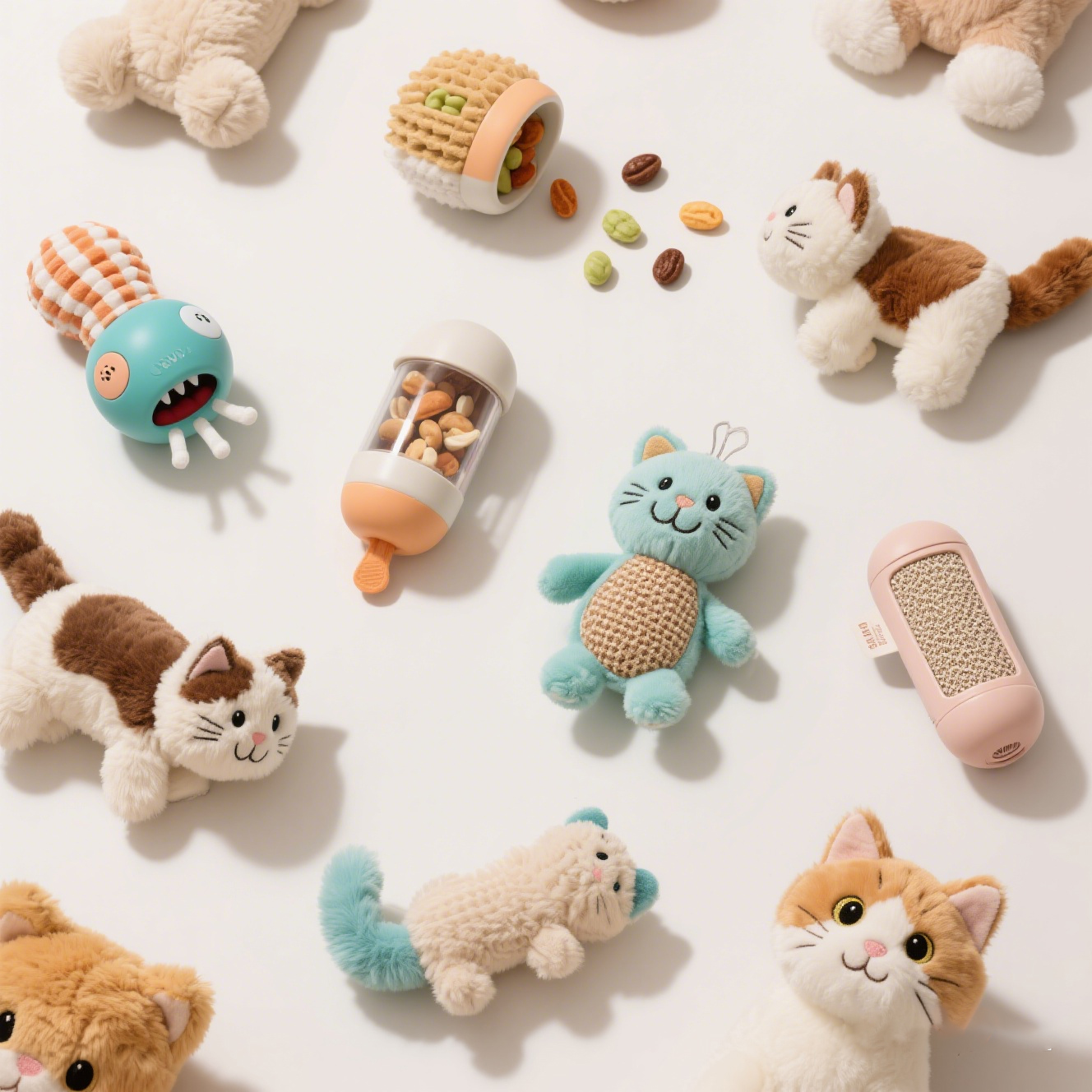
Once considered a niche subculture confined to Tokyo specialty shops and anime conventions, kawaii plush has evolved into a dominant commercial force across North American, European, and Australian lifestyle retail. Today, gift shops, bookstore chains, specialty apparel retailers, and lifestyle e-commerce brands routinely anchor their impulse-gift sections around cute plushies inspired by Japanese character aesthetics.
The commercial power of kawaii toys lies in their cross-generational buyer appeal. Unlike traditional realistic stuffed animals designed strictly for young children, Japanese-style plush characters attract Gen Z, Millennial, and Kidult consumers who purchase soft collectibles for desk decor, stress relief, bag personalization, and social gifting. This broader customer base translates into higher repeat purchase frequency, strong organic social media shareability, and year-round retail velocity that does not depend on fourth-quarter holidays.
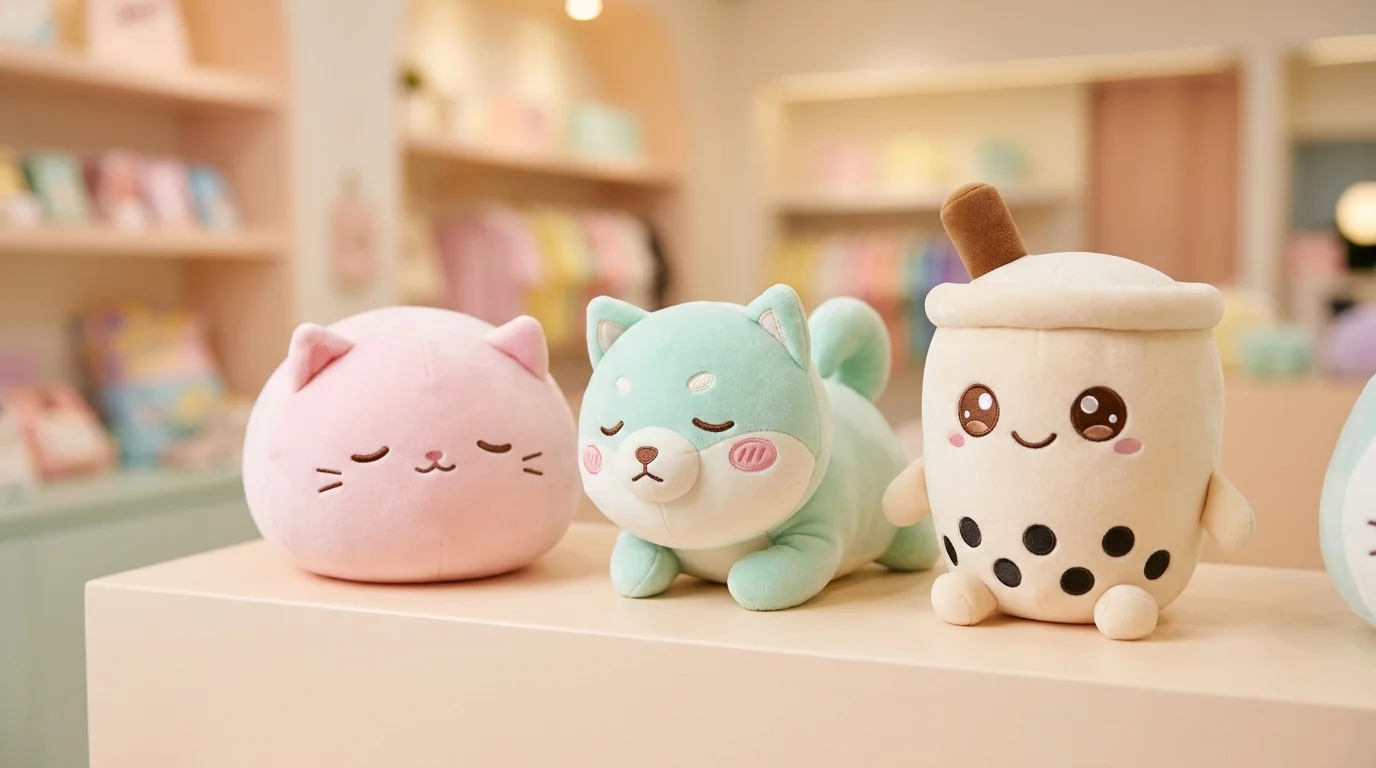
For product developers researching kawaii plush design ideas for gift brands, success is not a matter of random cuteness—it follows precise industrial design rules governing head-to-body ratios, facial placement, pastel color calibration, and compressible spandex-blend textiles. Brands that master these engineering fundamentals can turn simple 2D illustrations into high-margin collectible lines.
2. Anatomy of Kawaii Design: Proportions, Facial Placement, and Pastel Palettes
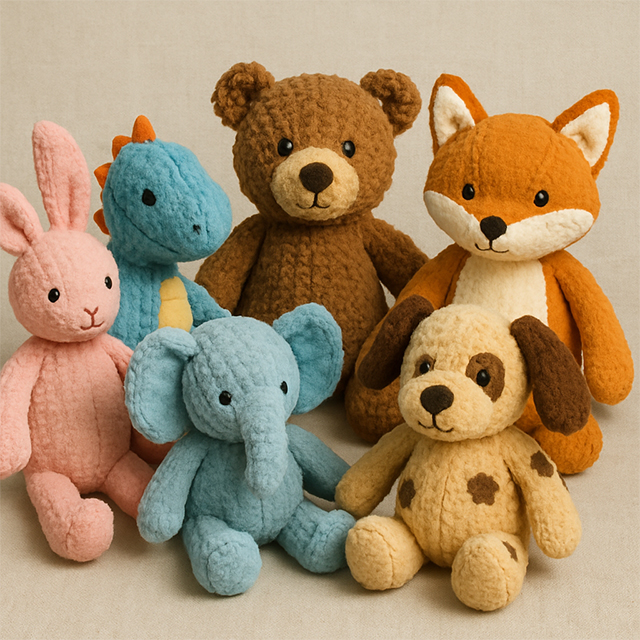
Translating a flat character illustration into an authentic three-dimensional kawaii stuffed animal requires deliberate geometric simplification. Where Western heritage plush often emphasizes anatomical realism—such as elongated snouts, defined joints, and shaded airbrushing—Japanese-style kawaii character engineering relies on three core structural principles:
- Chibi & Mochi Proportions (1:1 to 1:1.5 Ratio): Oversized, rounded heads paired with compact, stubby torsos and simplified limbs, or unified egg-shaped and cylindrical silhouettes that fit naturally in the palm or arms.
- Low-Set Horizontal Facial Alignment: Positioning the eyes and mouth along a low horizontal axis near the center of the face, with wide inter-ocular spacing and a tiny nose or cat-mouth (‘w’ shape) placed directly between the eyes to trigger instant visual warmth.
- Desaturated Pastel & Marshmallow Colorways: Replacing harsh primary colors with soft sakura pink, matcha mint, taro lavender, buttercream yellow, and milk-tea beige, accented by oval pink cheek blushes.
Because minimalist kawaii faces rely on very few lines, millimeter-level pattern accuracy is critical. A two-millimeter shift in eye spacing or mouth curvature during sewing can completely alter a character’s expression, which is why experienced custom anime and character plush manufacturers use laser-cut embroidery placement templates during sample development and bulk production.
3. High-Profit Kawaii Plush Product Formats for Lifestyle & Gift Brands
To maximize shelf productivity and encourage multi-item collecting, gift brands rarely launch a single standalone plush size. Instead, successful kawaii programs organize character IP across complementary product formats that serve distinct retail price tiers:
| Product Format | Typical Size Range | Core Target Use Case | Retail Merchandising Strategy |
|---|---|---|---|
| Palm-Sized Blind Box & Mini Plush | 8 cm – 12 cm | Desk companions, mystery series collecting | Countertop PDQ trays, impulse checkout add-ons |
| Bag Charm & Keychain Plush | 10 cm – 14 cm | Backpack accessories, tote bag styling | Pegboard walls, bundled gift sets |
| Medium Mochi Squish Plush | 20 cm – 30 cm | Core gift item, bedroom shelf display | Main feature tables, themed seasonal collections |
| Jumbo Hugger & Cushion Plush | 40 cm – 55 cm | Sofa lounging, high-value hero gift | Top-shelf visual anchors, VIP gift tiers |
Among these formats, anthropomorphized food and beverage objects—such as smiling boba milk teas, macarons, onigiri rice balls, croissants, and fruit animals—consistently rank among top-performing gift SKUs. Brands looking to test new original characters with minimal inventory risk frequently start with custom mini plush toys and collectible series before scaling the top-selling designs into 30 cm hugger cushions.
4. Tactile Engineering: Four-Way Stretch Mochi Minky and Down-Alternative Stuffing
Visual cuteness gets a shopper to pick up a kawaii plushie on a store display, but tactile hand-feel is what closes the sale. The signature ‘mochi’ or marshmallow squish sensation associated with modern Japanese plush cannot be achieved with stiff, woven-backed standard plush fabrics or coarse hollow fiber stuffing.
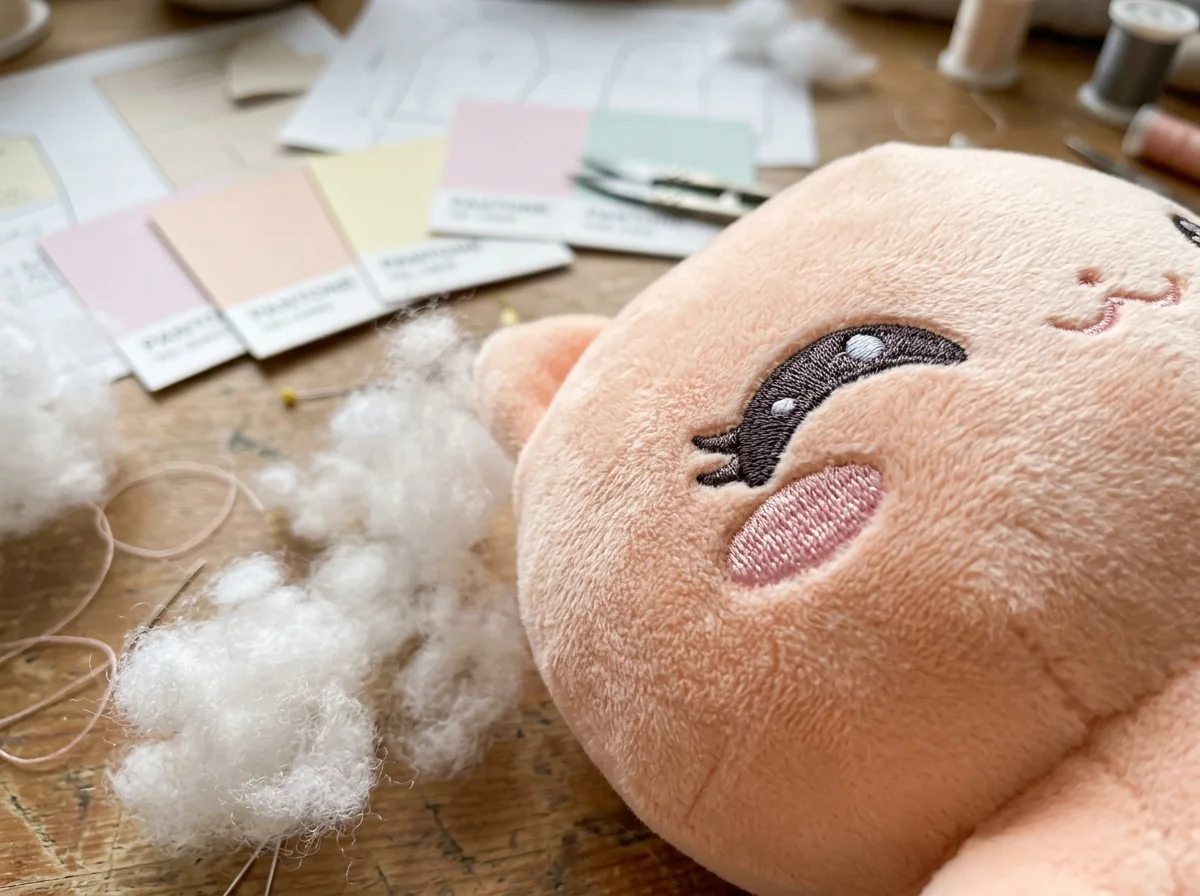
To create that ultra-soft, elastic squeeze, OEM engineers pair a 93% polyester / 7% spandex four-way stretch micro-velboa shell (often called spandex minky, with a 1.0–1.5 mm pile) with ultra-fine 0.7D to 1.2D siliconized micro-denier polyester fiberfill (commonly known as down-alternative PP cotton). Because four-way stretch fabric expands in all directions when stuffed, pattern makers must apply precise negative-ease compensation during custom plush pattern translation and sampling so the finished toy maintains a crisp silhouette without puckered seams.
For facial details on stretch fabrics, high-density computerized satin embroidery must be backed with soft non-woven water-soluble or tear-away stabilizer so the eye stitching does not pull or ripple the elastic shell. Cheek blushes can be executed either via oval satin-stitch embroidery or through non-toxic, colorfast textile airbrushing using dyes compliant with OEKO-TEX Standard 100 chemical safety benchmarks.
5. Safety Compliance, Packaging Presentation, and MOQ Planning
Even when kawaii plush lines are marketed heavily toward teenage and adult lifestyle buyers, customs authorities in the United States, European Union, and United Kingdom routinely classify all soft stuffed toys under children’s toy safety regulations. Consequently, every kawaii plush SKU must satisfy U.S. CPSC and ASTM F963 toy safety testing as well as European EN 71 harmonised toy safety standards for mechanical seam tension, flammability, and heavy-metal chemical migration.
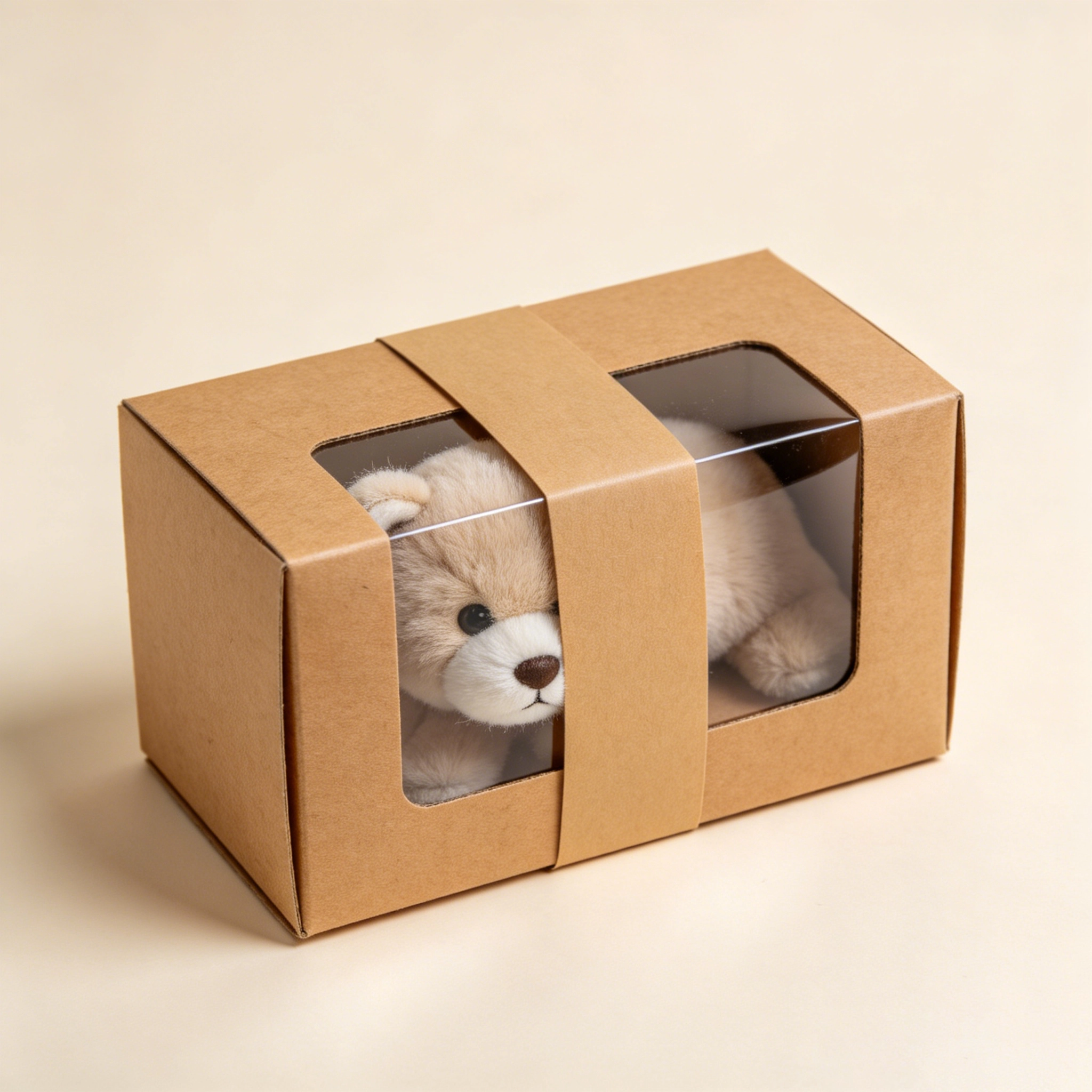
In retail merchandising, kawaii gift brands elevate perceived value through pastel die-cut hangtags, custom woven satin tush labels, and collectible character bio cards that give each plushie a name and personality backstory. Standard OEM MOQs for custom spandex minky kawaii plush range from 1,000 to 2,000 pieces per character, with 500-piece starter runs available when utilizing mill-stocked pastel fabric shades.
6. Frequently Asked Questions (FAQ)
Q: What makes a ‘mochi’ kawaii plush feel different from a standard stuffed animal?
A: Standard plush uses non-stretch woven-back velboa and 7D/15D hollow polyester fiber, which feels firm and structured. Mochi kawaii plush combines a 4-way stretch spandex-polyester shell with ultra-fine 0.7D–1.2D micro-denier down-alternative fiberfill, producing a slow, marshmallow-soft compress and instant rebound.
Q: How do you prevent embroidery from puckering on stretchy spandex minky fabric?
A: OEM embroidery technicians hoop the spandex minky with a specialized dual-layer backing stabilizer, calibrate thread tension lower than standard woven plush, and adjust stitch density so the embroidered eyes lie flat without distorting the surrounding elastic fabric.
Q: Is embroidered blush or airbrushed blush better for kawaii stuffed animals?
A: Oval satin-stitch embroidered blush offers permanent wash durability, consistent batch uniformity, and zero fading, making it the preferred choice for retail scale. Airbrushed or heat-sublimated blush provides a softer gradient look but requires strict colorfastness control across production batches.
Q: Can we launch a blind-box kawaii mini plush series with multiple characters?
A: Yes, brands frequently develop 4 to 6 mini kawaii characters (8–10 cm) that share the same base body pattern and fabric palette while varying the ear shapes, facial expressions, and held accessories. Sharing core fabrics helps optimize MOQ and unit tooling costs across the series.
Q: Do kawaii plush bag charms with metal keyrings pass children’s toy safety tests?
A: Yes, provided the metal keyring or lobster clasp is lead-free and nickel-compliant under CPSIA and REACH, and the fabric ribbon loop attaching the hardware to the plush body passes the 21 lbs (90N) tension pull test without tearing.
7. Develop Your Custom Kawaii Plush Line With Wehao Toys
Ready to Turn Your Cute Character Artwork Into a Bestselling Kawaii Plush Line? Achieving authentic Japanese-style chibi proportions, cloud-soft mochi spandex textures, and flawless facial embroidery requires precision pattern making and specialized textile sourcing. Wehao Toys partners with gift brands, IP creators, and retail buyers to deliver turnkey OEM and ODM kawaii plush manufacturing. Contact Wehao Toys for a Custom Plush Toy Project today to share your character sketches, request fabric swatch recommendations, and start your custom prototype.