1. The Direct Answer: When Can You Split a Plush Toy MOQ—and When Can’t You?
Yes—you can often split a plush toy MOQ per design across multiple colorways or closely related character variations, provided the SKUs share the same core cutting patterns or utilize mill-stocked fabrics. However, if you want to split a single 1,000-piece minimum order across four completely unrelated characters with different body sizes, custom-dyed Pantone fabrics, and unique 3D patterns, factories will treat them as four separate production runs, each subject to its own minimum order quantity.
Understanding why OEM manufacturers enforce minimums is the key to negotiating flexible mixed SKU plush orders. A plush factory’s MOQ is not an arbitrary sales rule—it is dictated by upstream textile mill dyeing vats, laser-cutting setup times, embroidery machine hoop programming, and sewing line balancing. Once buyers understand which production steps create fixed setup costs, they can engineer multi-SKU collections that satisfy factory efficiency while keeping inventory risk low.
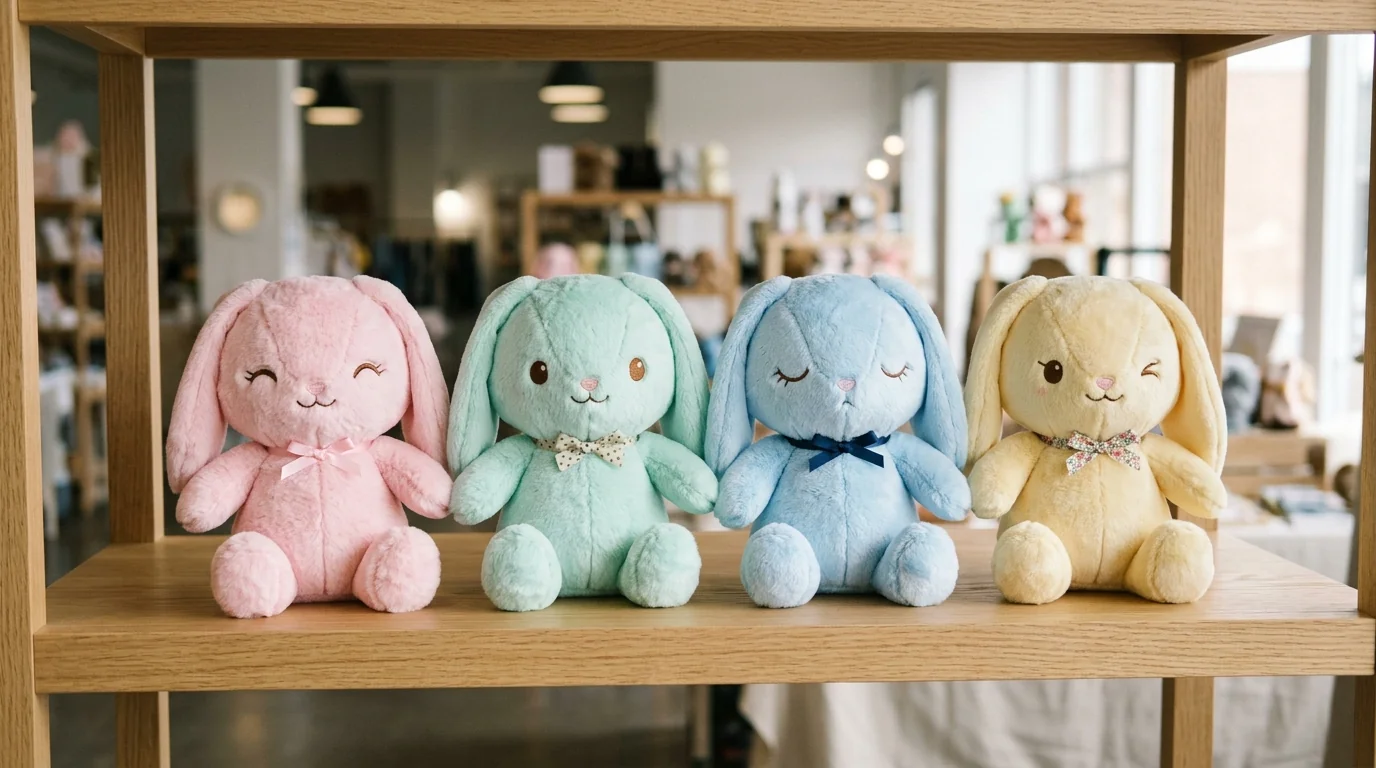
Whether you are launching a boutique retail line of custom animal plush toys or testing a multi-character blind-box assortment, structuring your designs around shared patterns and stock textiles unlocks low-MOQ multi-SKU flexibility.
2. Does Each Plush Color Have a Separate Minimum Order Quantity?
When buyers ask does each plush color have a separate minimum order quantity, the answer depends entirely on whether the fabric is **mill-stocked (market fabric)** or **custom-dyed to a specific Pantone (PMS) code**:
- Stock / Market Fabric Colors (Low or Split MOQ): Major plush textile mills maintain ready-to-ship rolls of crystal velboa, minky, and faux fur in 80 to 120 popular shades. Because the factory can purchase as little as one roll (50 to 80 meters) per color from stock, a 1,000-piece order of a 20 cm bunny can easily be split into four colors of 250 pieces each (e.g., pink, mint, blue, and yellow) using the exact same cutting dies.
- Custom Pantone-Dyed Fabrics (Strict Mill Vat MOQ): If your brand requires a custom-dyed fabric shade that does not exist on stock swatch cards, the dyeing mill requires a minimum dye vat of 300 kg to 500 kg of raw greige fabric—enough to produce 2,500 to 4,000 medium plush toys in that single color. Splitting below that threshold requires paying a $150 to $300 small-vat dyeing surcharge per color.
Therefore, the most effective way to lower your custom plush MOQ per color is to request physical stock swatch books during custom plush development and fabric sourcing and select the closest available ready-made shades rather than ordering custom dye lots for initial test runs.
3. Can I Split a Custom Plush MOQ Across Different Characters?
For creators and merchandise buyers asking can I split a custom plush MOQ across different characters, the feasibility comes down to **pattern sharing**. In a sewing workshop, operators work in specialized assembly lines where each sewer repeats a specific seam (such as attaching arms or closing the head gusset). Every time the line switches to a completely new 3D body geometry, productivity drops by 30% to 50% during the learning curve.
| Multi-SKU Order Scenario | Pattern & Fabric Overlap | Typical Factory MOQ Policy | Cost & Setup Impact |
|---|---|---|---|
| 1 Base Body + 4 Stock Colors | 100% shared cutting pattern; 4 stock minky colors | Can split 1,000 MOQ into 4 × 250 pcs per color | Zero extra pattern fee; minimal cutting setup |
| 1 Base Body + 3 Modular Accessories | 100% shared body/fabric; swap hats, bows, or scarves | Can split 1,000 MOQ into 3 × 330 pcs per style | Low accessory sampling fee; shared bulk fabric |
| Shared Torso + Different Ears/Faces (Chibi Series) | 80% shared torso/limbs; unique ear/tail panels & embroidery | 500 pcs per character (e.g., 3 characters = 1,500 total) | Separate head/embroidery setup; shared body line |
| 4 Completely Different Animals & Sizes | 0% pattern overlap; different fabrics and proportions | Full MOQ required per design (e.g., 500–1,000 pcs each) | 4× sampling, pattern, and lab testing setups |
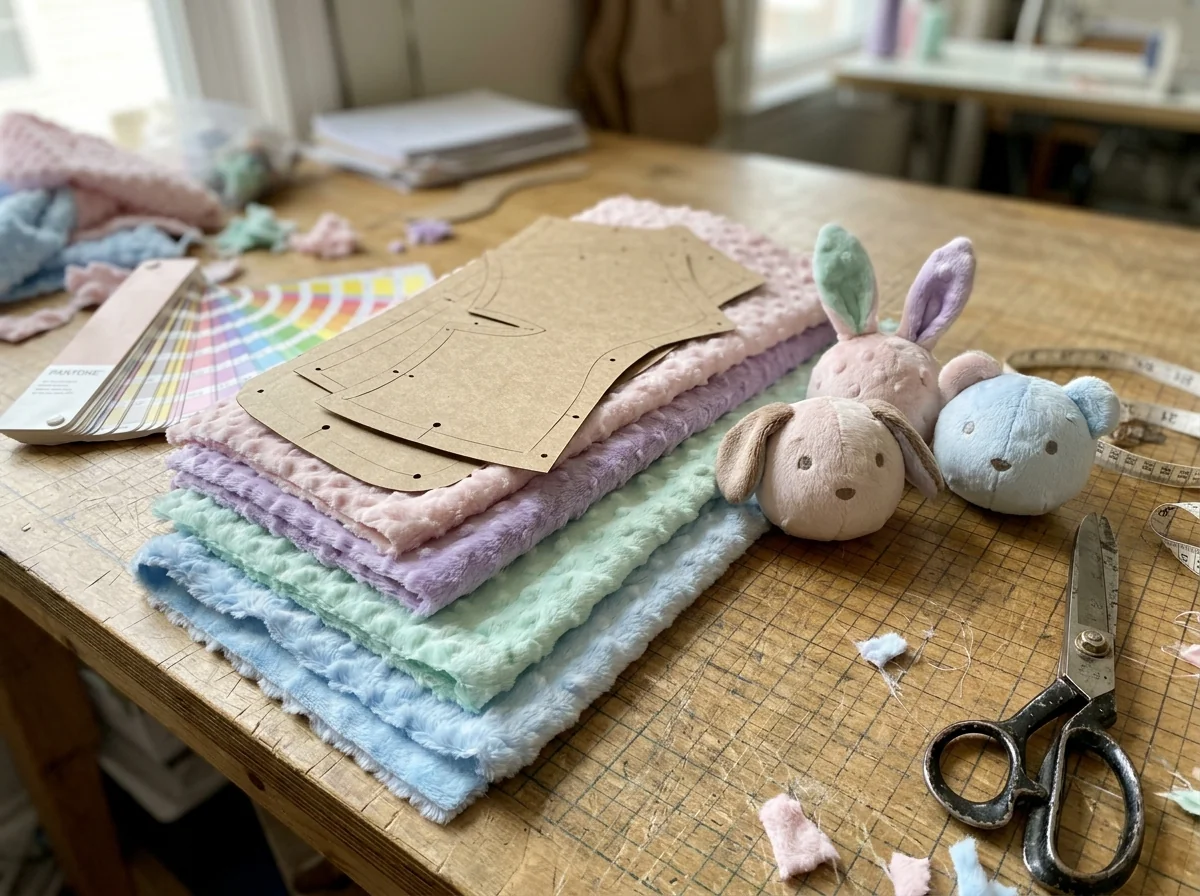
As shown above, answering can shared fabrics and patterns make mixed SKU orders easier is a resounding yes. By designing a ‘platform body’—where a bear, cat, bunny, and puppy all share the exact same seated torso, arms, legs, and round head pattern, differing only in their top ear attachments and facial embroidery—brands can launch a 4-character collection in custom mini plush toys and collectible series with significantly lower plush character order quantities per SKU.
4. How Multi-Color and Multi-Character Splits Affect Safety Testing Costs
One critical factor buyers often overlook when splitting MOQs across colors is third-party laboratory testing. Under both U.S. CPSC and ASTM F963 toy safety rules and European EN 71 harmonised toy safety standards (specifically EN 71-3 chemical migration of heavy elements), testing laboratories charge chemical analysis fees **per material and per color**.
While composite testing allows labs to combine up to three similar textile colors in a single test run, adding ten different fabric colors across a tiny 1,000-unit split order will multiply your chemical testing bill. To keep compliance costs lean while adhering to plush toy safety standards and compliance and OEKO-TEX Standard 100 guidelines, smart buyers share a common palette of white, cream, and black accent fabrics across all characters in the assortment, limiting unique color variations to the primary outer shell.
5. Frequently Asked Questions (FAQ)
Q: What is the lowest realistic MOQ per character for a custom plush startup brand?
A: When using mill-stocked velboa or minky colors and standard embroidered details, flexible OEM factories can support trial runs of 500 pieces per character design—or split a 1,000-piece run into two 500-piece colorways of the same pattern.
Q: Can we split a 1,000-piece MOQ across two different sizes of the same character (e.g., 15 cm and 30 cm)?
A: Even though a 15 cm keychain plush and a 30 cm hugger plush depict the same character, they require completely separate 3D patterns, cutting dies, and embroidery file scaling. However, because they consume the exact same fabric rolls, factories can usually accommodate 500 pieces of each size under one shared material order.
Q: Does splitting an order across multiple characters increase the sampling fee?
A: If the characters only change fabric color on the exact same pattern, you typically only need one master structural prototype plus color swatch confirmation. If each character requires unique ear patterns and new facial embroidery digitizing, each variation incurs its own sampling fee.
Q: How can we create multiple SKUs from one plush body without changing the animal species?
A: The most cost-effective method is designing one core mascot body (such as a 20 cm bear or capybara) and creating 3 to 4 seasonal or themed SKUs by swapping low-MOQ removable accessories like knitted scarves, miniature backpacks, printed T-shirts, or embroidered hats.
Q: Can hangtags and woven labels be split across mixed SKU plush orders?
A: Yes, woven tush labels are usually identical across your entire brand line (sharing one 2,000-piece label MOQ), while paper hangtags can be gang-printed on a single offset press sheet so each character gets its own custom barcode and artwork at minimal extra cost.
6. Plan Your Multi-SKU Custom Plush Assortment With Wehao Toys
Want to Launch Multiple Plush Colors or Characters Without Over-Ordering Inventory? Smart pattern engineering and shared fabric planning let you build a diverse, retail-ready plush collection while keeping MOQs and tooling budgets under control. Wehao Toys helps emerging brands, IP creators, and retail buyers structure flexible mixed-SKU production runs using stock minky palettes and modular character templates. Contact Wehao Toys for a Custom Plush Toy Project today to review your character lineup and get a tailored MOQ and sampling proposal.