
1. Why Every B2B Plush Order Needs a Standardized Defect Classification Checklist
Because stuffed animals are assembled through dozens of manual cut-and-sew, turning, hand-stuffing, ladder-stitch closing, and brushing operations, slight unit-to-unit variations are inherent to plush manufacturing. However, without a written plush toy inspection defect checklist agreed upon before production begins, factory quality supervisors and third-party inspectors may disagree on whether a crooked ear or a loose thread constitutes a rejectable flaw.
In international toy procurement, pre-shipment inspections are governed by statistical Acceptance Quality Limit (AQL) sampling protocols defined under ANSI/ASQ Z1.4 and ISO 2859-1 sampling standards. Under standard General Inspection Level II for plush toys, buyers typically set **Critical Defects to AQL 0.0 (zero tolerance)**, **Major Defects to AQL 1.5 or 2.5**, and **Minor Defects to AQL 4.0**. Defining exactly which physical flaws fall into each bucket ensures objective pass/fail decisions before final balance payment and container loading.
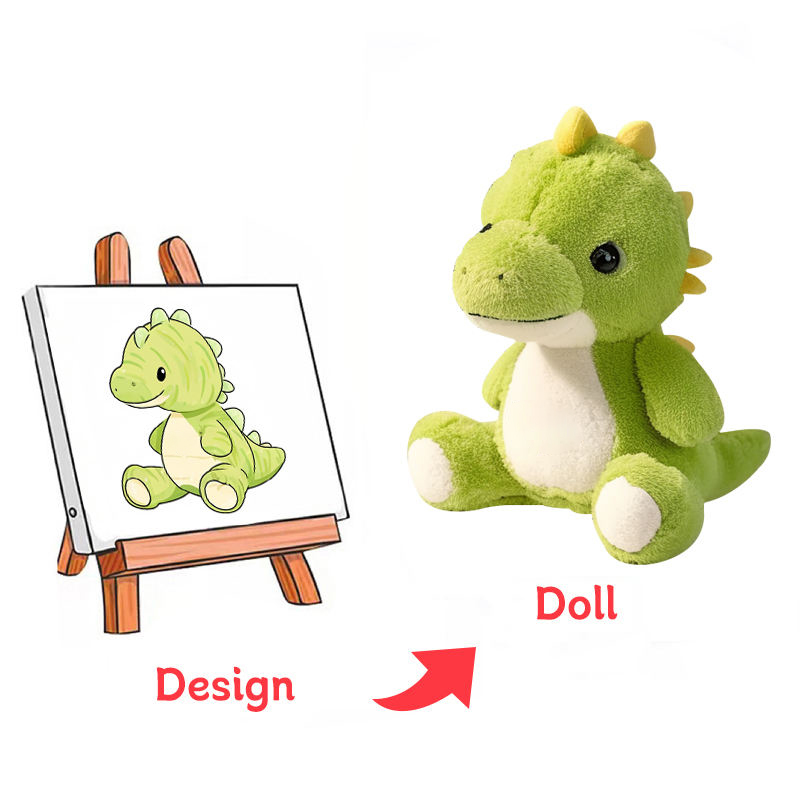
Establishing a clear stuffed animal quality checklist alongside your sealed Golden Sample during custom plush development and quality assurance planning protects your brand from both safety recalls and customer returns.
2. How Do Safety Defects Differ From Cosmetic Plush Defects? (Critical, Major & Minor)
For sourcing teams asking how should buyers classify defects in a plush toy inspection—and specifically how do safety defects differ from cosmetic plush defects—the distinction rests on three criteria: **regulatory/physical harm**, **functional/commercial unsellability**, and **minor visual imperfection**:
- Critical Defects (AQL 0.0 – Zero Tolerance): Any condition that poses a physical injury hazard to a child or end user, or violates mandatory legal regulations. Finding even one Critical defect—such as a broken sewing needle fragment inside the stuffing, a plastic eye detaching under pull-force testing, sharp wire/plastic burrs, mold/mildew, or missing mandatory CPSIA/CE safety warnings—automatically fails the entire lot and triggers a 100% re-inspection.
- Major Defects (Typically AQL 1.5 or 2.5): Functional or structural flaws that do not endanger safety but make the toy unsellable at retail or likely to be returned by a customer. Examples include open seams or ladder-stitch gaps (>2 mm), exposed raw stuffing, severely asymmetrical eyes or ears, wrong Pantone fabric shade, permanent oil/ink stains (>3 mm), or non-scannable barcodes.
- Minor Defects (Typically AQL 4.0): Slight workmanship or cosmetic deviations that do not affect safety or functionality and would rarely be noticed by an average consumer at arm’s length—such as an untrimmed loose thread end (<10 mm), minor carton scuffing, or a hangtag crease.
When inspecting specialized categories such as infant plush or durable pet plush toys, seam openings and stuffing retention are evaluated even more strictly, as exposed fiberfill or loose internal squeakers represent immediate ingestion hazards.
3. Master Plush Toy Inspection Defect Classification Table
Attach the following defect classification matrix directly to your Purchase Order and third-party inspection booking sheet:
| Inspection Area | Critical Defect (AQL 0.0) | Major Defect (AQL 1.5 / 2.5) | Minor Defect (AQL 4.0) |
|---|---|---|---|
| Metal & Sharp Objects | Broken needle fragment, staple, pin, or sharp wire detected | Plastic tag barb left inside fur; rough zipper tooth edge | Slightly stiff woven label corner (non-sharp) |
| Seams & Stitching | Seam bursts below required 90N (21 lbs) safety pull test | Open seam hole >2 mm; exposed stuffing; skipped lockstitch | Slightly uneven back-closing ladder stitch (<3 mm) |
| Eyes, Nose & Hardware | Plastic eye/nose detaches during pull/torque test (choke hazard) | Crooked/asymmetrical eyes (>3 mm off); scratched plastic eye | Tiny thread tail (<5 mm) at corner of embroidered eye |
| Shape, Stuffing & Weight | Contaminated, damp, or foul-smelling interior filling | Under-stuffed (>10% below Golden Sample weight); twisted limb | Slight stuffing unevenness easily fixed by hand patting |
| Fabric & Cleanliness | Mold, mildew, insect infestation, or chemical odor | Oil/glue stain >3 mm; fabric hole; wrong color shade; bald fur spot | Loose surfacelint or unbrushed seam fur easily brushed out |
| Labels & Packaging | Missing suffocation warning on polybag; missing tracking label | Wrong SKU barcode; torn retail box; incorrect washing symbols | Slightly crooked polybag sticker (<5° tilt) |
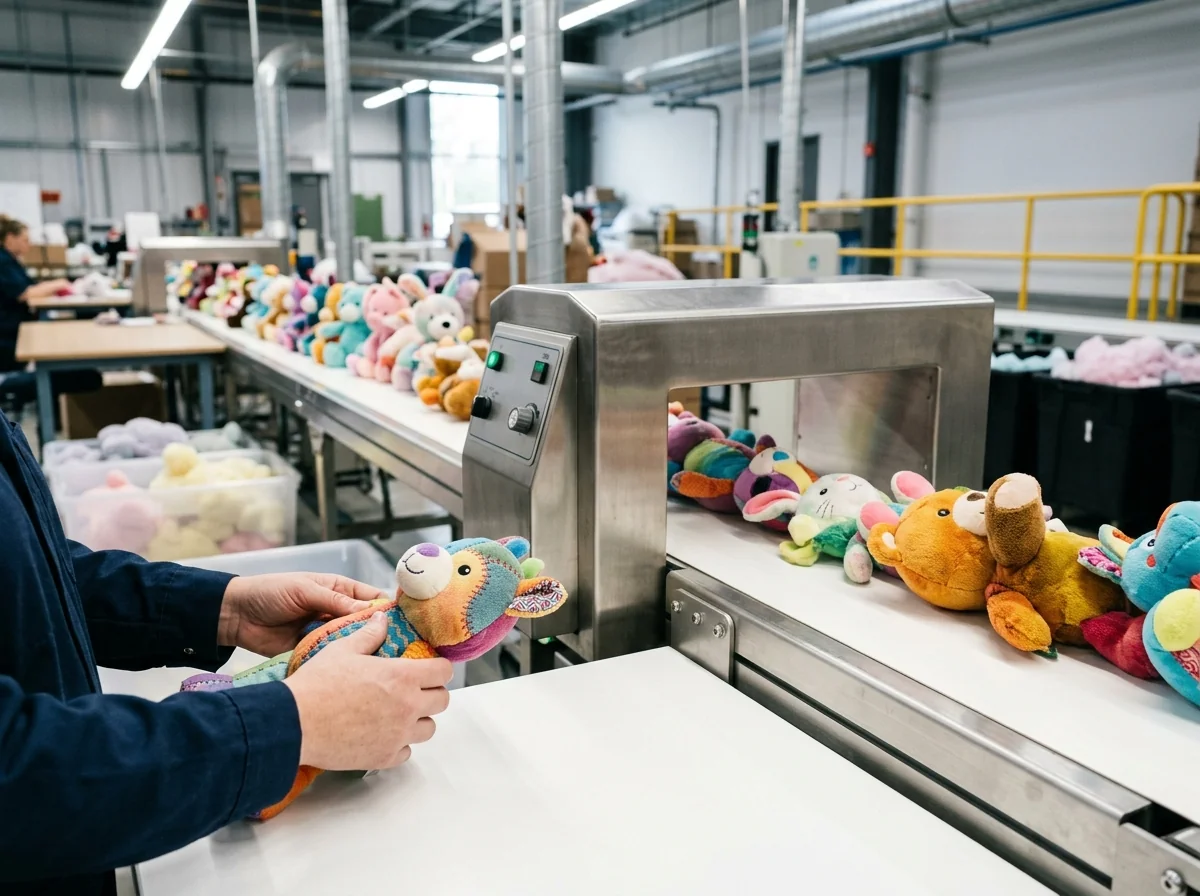
To prevent Critical metal contamination, every finished plush toy must pass through a calibrated conveyor-belt ferrous/non-ferrous metal detector (calibrated hourly with a 1.0 mm to 1.2 mm test sphere) immediately before polybag sealing.
4. What Should a Custom Plush Pre-Shipment Checklist Cover On-Site?
Beyond visual defect counting, a comprehensive plush pre-shipment inspection (conducted when at least 80% to 100% of the order is packed in export cartons) must include four physical on-site verification tests:
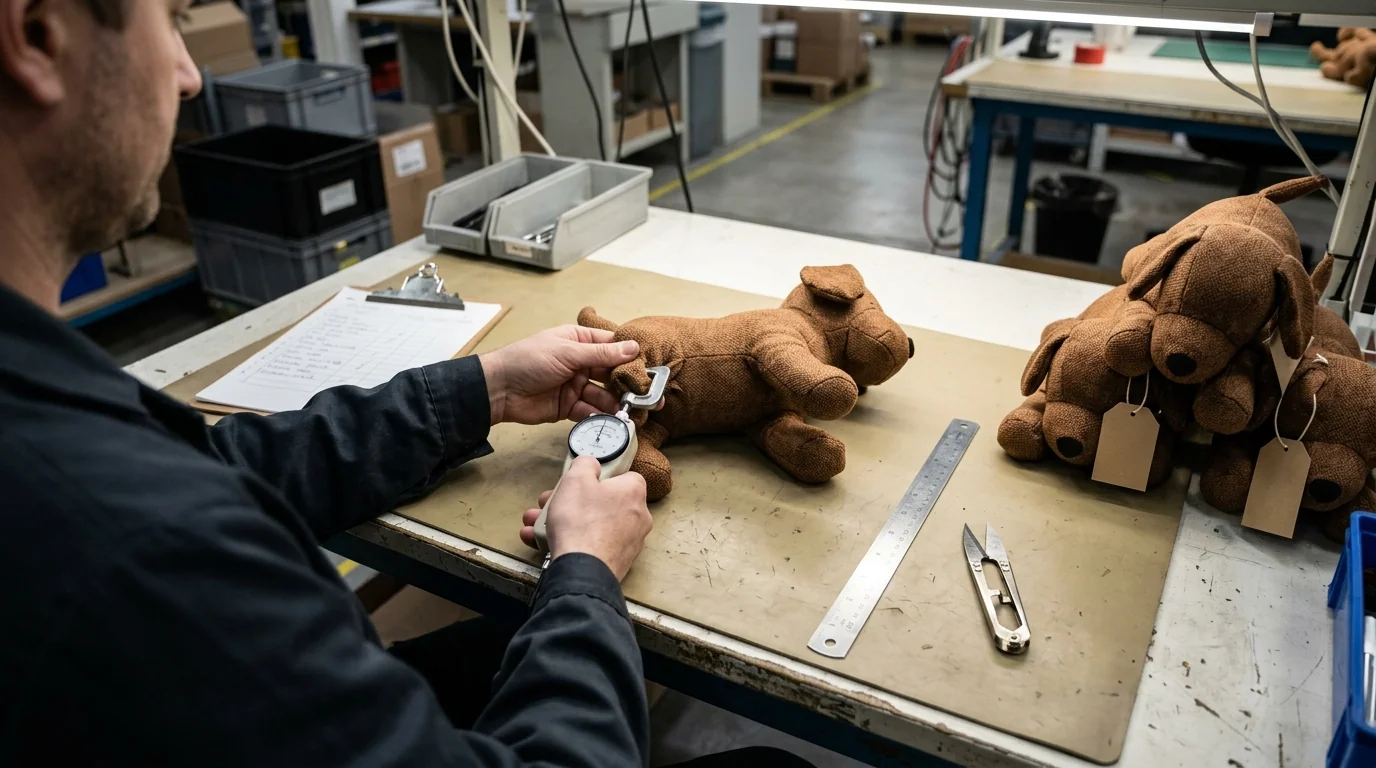
First, **Golden Sample & Dimension/Weight Comparison**: The inspector weighs and measures 10 to 20 random units against the sealed Golden Sample, verifying that net weight and dimensions fall within the ±5% tolerance. Second, **Mechanical Seam & Attachment Pull Testing**: Using a calibrated push-pull force gauge, the inspector applies 21 lbs (90N) of tension for 10 seconds to eyes, noses, ears, limbs, and seams in accordance with plush toy safety standards and compliance, U.S. CPSC and ASTM F963 mechanical test procedures, and European EN 71 harmonised toy safety standards. Third, **Barcode & Label Verification**: Scanning retail UPC/EAN barcodes and FNSKU stickers with a handheld scanner to guarantee 100% readability at retail checkout. Fourth, **Carton Drop & Moisture Check**: Performing a 10-point carton drop test and checking master carton moisture content (<12%) to prevent mold during ocean transit.
5. Frequently Asked Questions (FAQ)
Q: What is the standard AQL level used for custom plush toy inspections?
A: The global toy industry standard is General Inspection Level II under ANSI/ASQ Z1.4 (ISO 2859-1), with Critical defects set to 0.0, Major defects set to 1.5 (for premium retail brands) or 2.5 (for standard wholesale), and Minor defects set to 4.0.
Q: Why is the hand-sewn closing seam on the back or bottom of a plush toy often inspected closely?
A: After a plush shell is machine-sewn inside-out, turned right-side-out, and stuffed with fiberfill, the final 4 to 6 cm stuffing opening is closed by hand using an invisible ladder stitch. If the operator uses single thread instead of doubled high-tensile thread or spaces stitches >3 mm apart, that seam can pop open under squeezing.
Q: How is ‘trapped fur in seams’ classified during a plush inspection?
A: On medium- and long-pile plush toys, fur fibers frequently get caught in the machine seam during sewing. If the trapped fur creates a visible bald line or distorts the facial expression and was not brushed out by finishing workers, it is classified as a Minor defect (or Major if on the center face).
Q: What happens if a shipment fails AQL pre-shipment inspection for Major or Minor defects?
A: If the defect count exceeds the AQL rejection threshold, the factory is required to unpack the lot, perform a 100% sorting and rework operation (such as re-stitching ladder seams, brushing fur, or trimming threads), and present the goods for a re-inspection before shipment release.
Q: When should an inline inspection (DUPRO) be booked instead of waiting for pre-shipment inspection?
A: For orders exceeding 5,000 units or complex multi-character launches, conducting a During Production Inspection (DUPRO) when 15% to 20% of the goods are sewn catches systemic embroidery or stuffing issues early enough to fix them on the assembly line.
6. Ensure Zero-Defect Plush Manufacturing With Wehao Toys
Need a Manufacturing Partner With Strict In-House Quality Control and AQL Standards? Preventing defects on the production line is always faster and more reliable than catching them at the loading dock. Wehao Toys integrates 100% conveyor metal needle detection, in-line seam tension pull testing, and strict AQL 1.5/2.5 pre-shipment inspections across every custom plush project. Contact Wehao Toys for a Custom Plush Toy Project today to review our quality control workflow and start your next custom plush order with confidence.