1. Why Attachment Failures Are the #1 Source of Negative Reviews on Plush Bag Charms
Clip-on plush bag charms, blind-box pendant plushies, and promotional mascot keychains are carried everywhere—dangling from commuter backpacks, school tote bags, luggage zippers, and car keys. Unlike a bedroom shelf plush that sits stationary, a keychain plush is subjected to constant walking bounce, rotational twisting, and sudden snags on subway doors or chair armrests. When a customer discovers that their collectible plush charm fell off their bag and vanished in transit, they blame the brand immediately.
Implementing rigorous plush keychain attachment quality checks before mass production with a custom plush keychain manufacturer eliminates the three root causes of field failure: ribbon loop pull-out at the crown seam, un-soldered jump rings spreading open under tension, and brittle ball-chain connectors snapping during everyday wear.
2. What Can Cause Plush Keychain Hardware to Become Loose or Detach?
To understand what can cause plush keychain hardware to become loose, quality engineers inspect the entire load-bearing chain from the top of the plush head up to the metal clasp:
- 1. Shallow Seam Insertion & Raw Ribbon Fraying: If the fabric hanging loop (satin ribbon, grosgrain tape, or cotton cord) is inserted less than 5 mm into the top head seam without heat-sealing and folding the raw cut ends, the slippery polyester yarns unravel inside the seam and slide right out under a 5-pound tug.
- 2. Single-Pass Seam Stitching Without Back-Tacking: Running a single standard lockstitch across a smooth satin loop leaves a weak point right at the crown of the head. When the loop is yanked sideways, the seam thread parts and exposes a hole.
- 3. Open (Unwelded) Wire Jump Rings: Many low-cost factories connect a split ring to the clasp using a thin 1.0 mm open wire jump ring pinched shut with pliers. Under a 15–20N snag, the wire gap pries open and drops the plush.
- 4. Low-Grade 2.0 mm Ball-Chain Crimp Sleeves: Standard beaded ball chains frequently fail at the tiny sheet-metal coupling clasp when used on heavier 12–15 cm stuffed charms unless upgraded to ≥2.4 mm heavy-gauge brass/steel or protected with a plastic safety sleeve.
- 5. Torsional Twisting Without a 360° Swivel Joint: If a fixed non-swivel hook is sewn tightly into a wide ribbon loop, constant spinning of the plush charm twists the ribbon into a tight rope and pries the metal ring apart.
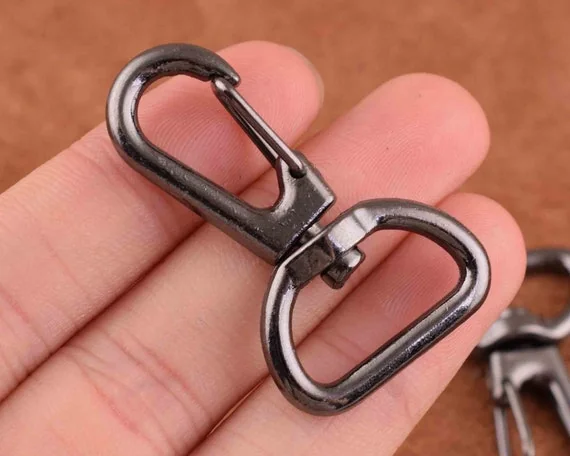
3. Hardware & Loop Engineering Comparison for Plush Bag Charms
During custom plush accessory and hardware selection, match your attachment design to the size, weight, and retail price point of your plush charm:
| Attachment Component | Weak / High-Risk Spec (Avoid) | Recommended B2B Engineering Spec | Target Pull Strength |
|---|---|---|---|
| Fabric Hanging Loop | Single-layer 6 mm smooth satin ribbon; 4 mm raw seam bite | Double-layer folded 10–12 mm grosgrain webbing or 3 mm braided nylon cord; ≥12 mm folded seam tail + bar-tack / box-X stitch | ≥ 90N – 120N (21–27 lbs) without seam slippage |
| Swivel Lobster Clasp | Thin stamped iron sheet hook; weak spring gate; non-swivel eye | Cast zinc-alloy swivel snap hook with 360° D-ring base and ≥5,000-cycle spring gate | ≥ 100N static load; smooth one-hand snap recovery |
| Keyring / Connecting Ring | 1.0 mm open wire jump ring (easily pulled apart by hand) | 25 mm double-coil flat tempered steel split ring OR brazed/welded closed jump ring | ≥ 120N without ring gap deformation |
| Beaded Ball Chain | 1.8–2.0 mm iron ball chain on heavy >50g plush | 2.4 mm heavy-duty nickel-free steel/brass ball chain (restrict to lightweight <35g charms) | ≥ 45N–60N (or pair with secondary keyring loop) |
4. How Should Buyers Inspect Attachment Loops and Hardware Before Bulk Production?
For QA managers asking how should buyers inspect attachment loops on plush keychains and which attachment checks should be agreed before bulk production, embed the following five-point test protocol into your Golden Sample sign-off and pre-shipment inspection sheet:
1. **Internal Seam Tail & Fold Inspection (Cut-Open Check)**: Cut open one pre-production head shell to verify that the ribbon or cord loop extends at least 12 mm to 15 mm inside the seam allowance, has its raw ends heat-fused, is folded over into a ‘T-anchor’ tab, and is double-stitched (or triple back-tacked) through the main head gusset.
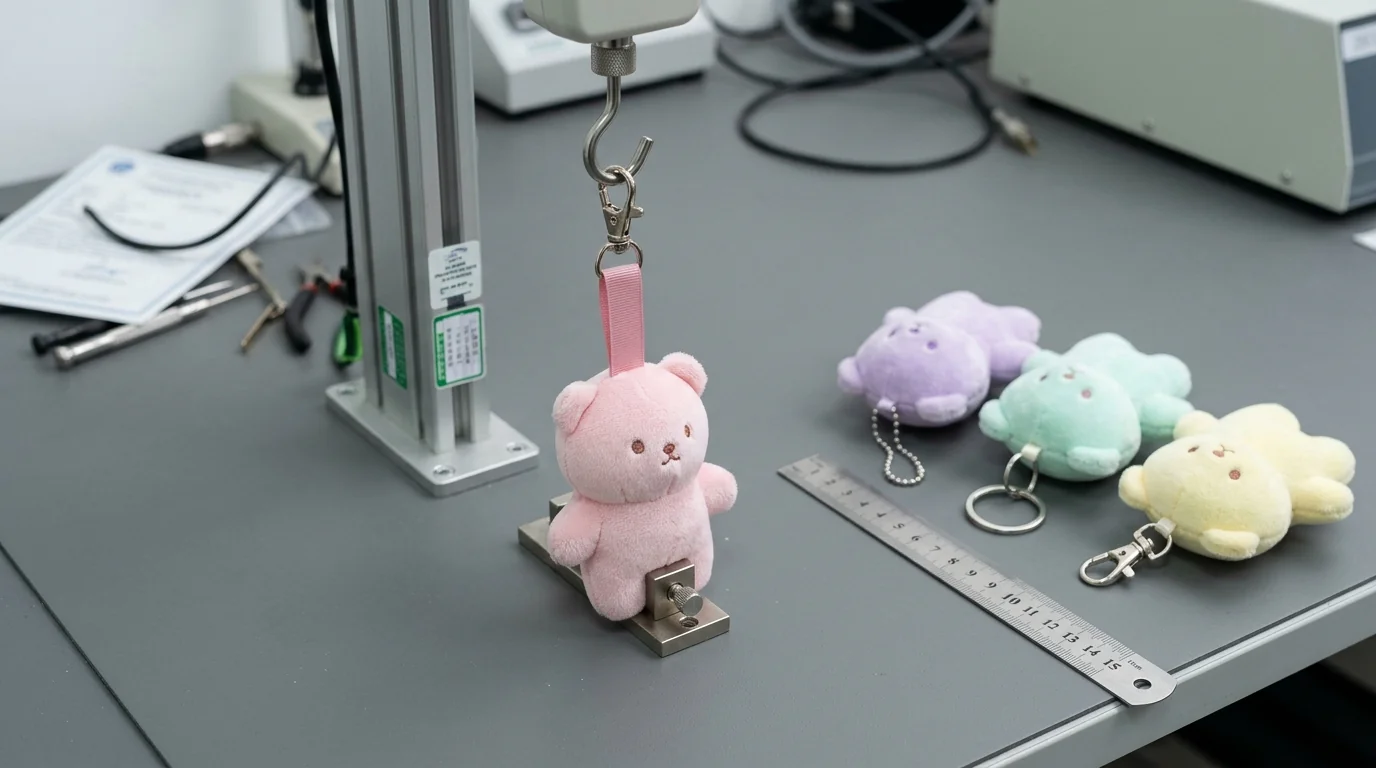
2. **90N (21 lbs) 10-Second Tension Pull Test (Axial & 45° Cross-Pull)**: Using a calibrated force gauge clamp, pull the metal hardware vertically and at a 45-degree angle against the plush body at 90N (21 lbs) for 10 full seconds in accordance with plush toy safety standards and compliance, U.S. CPSC and ASTM F963 mechanical tension standards, and European EN 71-1 physical test requirements. Zero seam tearing, thread popping, or ring opening is permitted.
3. **Clasp Gate Spring Cycle & Burr Check**: Compress and release the lobster clasp trigger 20 times rapidly to confirm snappy, complete gate closure with zero gap, and rub a cotton swab around the metal casting seams to ensure zero sharp metal burrs.
4. **24-Hour Salt-Spray Corrosion & Chemical Compliance (Lead/Nickel)**: Verify that electroplated gold, silver, or pastel painted clasps pass 24-hour neutral salt-spray rust testing, CPSIA total lead substrate limits (≤100 ppm), and EU REACH Annex XVII Entry 27 nickel-release limits.
5. **Metal Detector Workflow Timing**: Because zinc-alloy and steel keyrings trigger conveyor needle detectors, confirm that the factory passes the **stuffed plush bodies (with fabric loops only) through the 1.0 mm needle detector FIRST**, and attaches the metal clasps in a dedicated needle-free packing zone afterward.
5. Frequently Asked Questions (FAQ)
Q: If metal keyrings set off the needle detector, how do factories guarantee zero broken needles inside plush keychains?
A: Professional factories complete all sewing, stuffing, ladder-stitch closing, and fabric-loop anchoring first, then run the metal-free plush charms through the conveyor needle detector. Only after passing needle detection are the plush units moved to a segregated, needle-free hardware assembly table to attach the metal clasps.
Q: Why is grosgrain ribbon better than satin ribbon for plush keychain loops?
A: Grosgrain ribbon has raised horizontal ribs and a heavier weave that grips sewing threads firmly inside the crown seam, whereas ultra-smooth single-faced satin ribbon has low friction and is more prone to yarn slippage under heavy pulling forces.
Q: Can we use colorful plastic lobster clasps instead of metal hardware on plush bag charms?
A: High-impact POM (polyoxymethylene / acetal) plastic swivel clasps are an excellent, rust-proof, lightweight option that allows exact Pantone color matching and even lets the finished charm pass through ferrous needle detectors—provided virgin POM resin is used rather than brittle recycled ABS.
Q: Where is the strongest spot on a plush toy to sew the hanging loop?
A: The strongest anchor point is directly inside the top crown intersection seam where the front and back head gussets meet, allowing the loop tail to be caught by both the main overlock seam and a secondary reinforce bar-tack stitch.
Q: How do you prevent painted pastel metal clasps from chipping during ocean shipping?
A: Specify baked epoxy powder coating or rack electroplating rather than cheap barrel spray-painting, and wrap a tiny strip of protective tissue paper or foam film around the metal clasp before sealing the charm inside its polybag.
6. Source Durable, Pull-Tested Plush Keychains With Wehao Toys
Launching a Custom Plush Keychain, Bag Charm, or Blind-Box Pendant Line? Prevent field failures and customer returns with reinforced T-anchor grosgrain loops, heavy-duty zinc-alloy swivel clasps, and 90N tension testing on every production batch. Wehao Toys manufactures retail-grade custom plush keychains with strict needle-free hardware assembly and CPSIA/REACH compliant plating. Contact Wehao Toys for a Custom Plush Toy Project today to review hardware options and request a pull-tested custom keychain prototype.