1. Decoding the Capybara Plush Phenomenon in Global Novelty Retail
Over the past few years, the humble South American rodent has transformed from an obscure zoo animal into one of the most profitable icons in global gift and novelty retail. From claw machine arcades and lifestyle boutiques to major e-commerce marketplaces, the capybara plush has outperformed many traditional woodland and safari animals, capturing massive demand among Gen Z, Alpha, and young adult office shoppers.
What makes this surge so instructive for B2B product developers is that the capybara’s popularity is driven by a specific emotional and visual archetype: deadpan calm, unbothered resilience, and potato-shaped simplicity. Unlike high-energy cartoon characters that quickly feel dated, the capybara’s half-closed sleepy eyes, blunt rectangular snout, and rotund body act as a blank canvas for endless thematic customization.
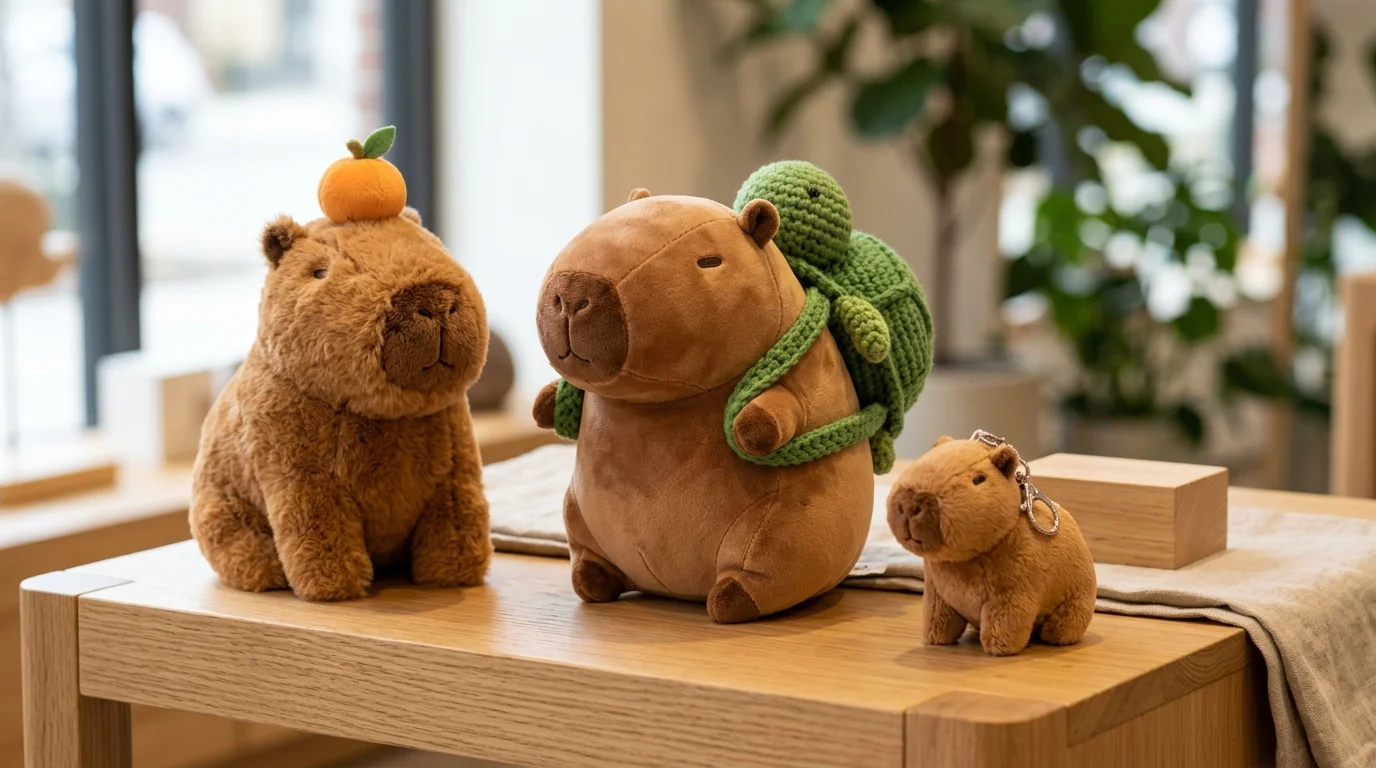
For sourcing teams evaluating capybara plush product ideas for novelty brands, the broader lesson extends far beyond a single animal species. Understanding how viral animal toys translate social media humor into modular, low-tooling-cost OEM product lines enables brands to capitalize on fast-moving animal plush trends without getting stuck with obsolete inventory.
2. Why Viral Animal Toys Succeed: Visual Simplicity and Modular Storytelling
When analyzing recent viral plush hits—from axolotls and Highland cows to frogs, tardigrades, and capybaras—a clear structural pattern emerges. The most commercially durable viral animal toys share three design traits that simultaneously benefit social media virality and factory production efficiency:
- Compact, Self-Standing Silhouettes: Chunky, potato-like or pear-shaped bodies with low centers of gravity that sit upright effortlessly on computer monitors, car dashboards, and retail shelves without toppling over.
- Expressive Micro-Contrast Faces: Minimalist half-moon embroidered eyes and straight-line mouths that convey a relatable ‘unbothered’ or cozy mood, making the plush highly photogenic in user-generated lifestyle videos.
- Detachable Prop & Costume Modularity: A neutral caramel or taupe base animal that can be accessorized with high-contrast props—such as a plush mandarin orange on the head, a removable green turtle shell backpack, a strawberry hood, or a wearable coffee cup sleeve.
From a B2B manufacturing perspective, this modularity is a major cost advantage. Rather than engineering ten completely separate animal body molds, a brand can perfect one core pattern in custom animal plush toys manufacturing and generate six distinct seasonal or collector SKUs simply by swapping the detachable miniature accessories.
3. Profitable Capybara Plush Product Ideas for Novelty & Lifestyle Brands
To differentiate a private-label collection from generic wholesale marketplace listings, novelty and gift brands must add functional or interactive value to their cute animal plush designs. Proven commercial formats include:
| Product Concept | Key Structural Feature | Target Retail Channel | MOQ & Cost Efficiency |
|---|---|---|---|
| Modular Dress-Up Capybara (20–25 cm) | Base plush with removable turtle bag, fruit hats, or knitwear | Gift boutiques, lifestyle chains, DTC brands | High: 1 base body shared across multiple outfit SKUs |
| Interactive Pull-String / Moving Tail Charm | Internal mechanical pull-cord vibrating or spinning orange prop | Trendy accessories stores, claw arcades | Medium: requires durable mechanical pull-box assembly |
| Bag Charm & Keychain Capybara (10–12 cm) | Metal lobster clasp with miniature plush prop attachment | Bookstores, apparel checkout counters | High: low fabric consumption, fast sewing cycle |
| Weighted Desk & Wrist-Rest Capybara | Flat-belly ergonomic posture filled with sealed PP pellets | Office lifestyle gift shops, gaming accessories | High: simple 4-panel gusset pattern |
Accessory-driven formats are particularly effective for testing new retail accounts. Many novelty brands pair a 25 cm hero plush with matching custom plush keychains and bag charms so teenage and adult shoppers can clip the character onto totes and backpacks, turning every customer into a walking billboard for the collection.
4. Material Selection & Construction Details for Textured Rodent Plush
Capturing the unmistakable look of a capybara requires contrasting two distinct brown textile textures between the snout and the torso. In professional OEM sampling, designers typically combine a longer, tousled faux fur or rabbit-touch plush (8–12 mm pile in warm chestnut or caramel) for the main body with a dense, short-pile 1.5 mm crystal velboa in dark cocoa brown for the blunt snout, inner ears, and webbed feet.
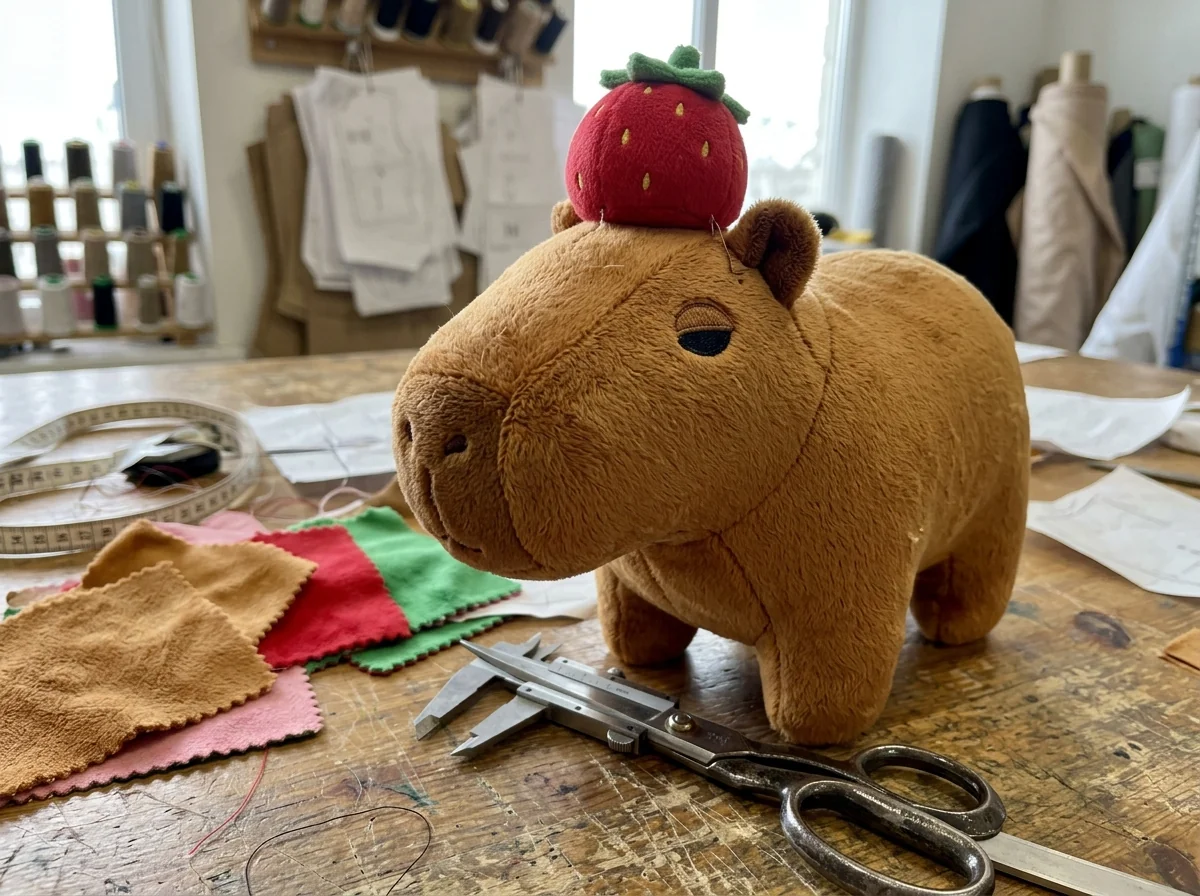
When sewing long-pile faux fur to short-pile snout panels, experienced technicians trim the seam allowance pile and brush trapped fibers out of the stitch line so the transition between the muzzle and cheeks looks clean and natural. For detachable accessories—such as knitted turtle backpacks or strawberry hats—factories use either reinforced elastic shoulder straps, concealed magnetic snaps sealed inside double-layer fabric pouches, or bar-tacked tacking stitches depending on the target age grade determined during custom plush development and sampling.
5. Speed-to-Market vs. Safety Compliance in Trend-Driven Plush
The biggest operational risk in viral animal plush trends is cutting regulatory corners in a rush to catch peak demand. Detachable miniature props (like tiny plush oranges, backpacks, or glasses), mechanical pull-string vibrators, and metal keychain clasps are prime targets for customs inspection and retail quality audits.
If a capybara plush is graded for children under 3 years old, any removable accessory that fits completely inside the small-parts test cylinder is strictly prohibited; in those cases, the orange topper or backpack must be permanently sewn onto the main body with reinforced seams that withstand 21 lbs (90N) pull-force testing under U.S. CPSC and ASTM F963 toy safety rules. Furthermore, all dyed brown fabrics, knitted yarns, and metal keychain hardware must comply with European EN 71 harmonised toy safety standards and OEKO-TEX Standard 100 textile safety criteria.
6. Frequently Asked Questions (FAQ)
Q: How quickly can an OEM factory turn a trending animal concept into a physical plush sample?
A: When provided with clear 2D turnaround sketches and reference dimensions, an experienced pattern room can deliver a first physical prototype within 7 to 10 working days using in-stock velboa, faux fur, and minky fabrics, allowing rapid market validation.
Q: How can brands test a viral plush trend without committing to massive inventory quantities?
A: The smartest strategy is the ‘one base body, multiple accessories’ method: order 1,000 units of the core caramel capybara body and split the run into three 330-unit sub-SKUs by pairing them with different low-MOQ accessories (such as an orange hat, a turtle backpack, and a festive scarf).
Q: Are removable plush accessories safe for all-ages toy certification?
A: Removable accessories are permissible for all-ages (0+) certification only if the detached accessory itself is large enough that it cannot fit inside the ASTM F963 / EN 71-1 small-parts choke test cylinder even under compression; otherwise, the accessory must be permanently stitched to the plush.
Q: What fabric combination works best for a fuzzy vs. smooth capybara plush?
A: For a shaggy, realistic look, use 10 mm curly faux fur (340 GSM) on the body with short 1.5 mm velboa on the snout and paws; for a squishy kawaii aesthetic, use 2.0 mm smooth caramel spandex minky across the entire body with dark brown satin embroidery.
Q: Can mechanical pull-string vibrating modules be washed inside a plush toy?
A: No, plush toys containing internal mechanical pull-cord boxes should carry a ‘Surface Wash Only’ care label, as submerging the plastic gear housing in water can corrode the internal spring mechanism.
7. Launch Your Trend-Driven Animal Plush Collection With Wehao Toys
Want to Capitalize on Viral Animal Plush Trends With Retail-Grade Quality? Turning fast-moving market trends into profitable, safety-compliant retail collections requires agile prototyping, modular pattern engineering, and dependable bulk production timelines. Wehao Toys helps novelty brands, gift retailers, and IP creators develop custom animal plush lines and accessory-driven series with flexible MOQs. Contact Wehao Toys for a Custom Plush Toy Project today to discuss your product concept, review modular MOQ options, and start rapid sample development.