
Quick Answer: AI Plush Toys Need More Than Soft Fabric to Be Safe
AI plush toys can be safe for kids only when the physical toy, electronic module, voice interaction system, privacy design, and age grading are all reviewed together. A soft outer fabric does not automatically make an AI plush toy safe.
Compared with regular stuffed animals, AI plush toys introduce extra risks. They may include batteries, speakers, microphones, Bluetooth, Wi-Fi, companion apps, cloud storage, voice recording, and chatbot responses. In the U.S., a child-focused smart plush toy may need to consider toy safety rules such as ASTM F963 and CPSIA requirements under 16 CFR Part 1250, as well as privacy rules such as COPPA when personal information is collected from children under 13.
For brands, the real question is not simply, “Is this plush toy cute?” The better question is, “Can this product stay physically safe, digitally safe, and developmentally appropriate during real use by children?”
What Makes AI Plush Toys Different from Regular Stuffed Animals?
A regular plush toy is usually evaluated through material safety, seam strength, filling safety, small-part risk, flammability, labeling, and age grading. These are already important for children’s toys.
An AI plush toy adds another layer. It may listen, respond, remember, connect to an app, or generate conversation. That means the product is no longer only a soft toy. It becomes a connected child-facing device.
This difference matters because children do not always use toys in a controlled way. They hug them, sleep with them, pull accessories, press buttons repeatedly, speak private thoughts, and sometimes treat talking toys like friends.
In our sampling experience, buyers often focus first on the AI function. They ask whether the toy can answer questions, tell stories, or act like a companion. But the safety review should start earlier. The plush body, electronics, battery access, microphone opening, speaker sound, and data flow all need to be considered before the first sample is made.
The Main Safety Risks Buyers Should Review
1. Physical Toy Safety
The plush body still needs to meet normal children’s toy safety expectations. For the U.S. market, brands should review AI plush toys together with children’s plush toy safety standards, not treat them as simple gift plush items.
For plush toys, this usually means reviewing:
- Seam strength
- Small parts
- Sharp points or edges from internal components
- Filling safety
- Surface coating and print safety
- Accessory attachment strength
- Flammability
- Age grading and warning labels
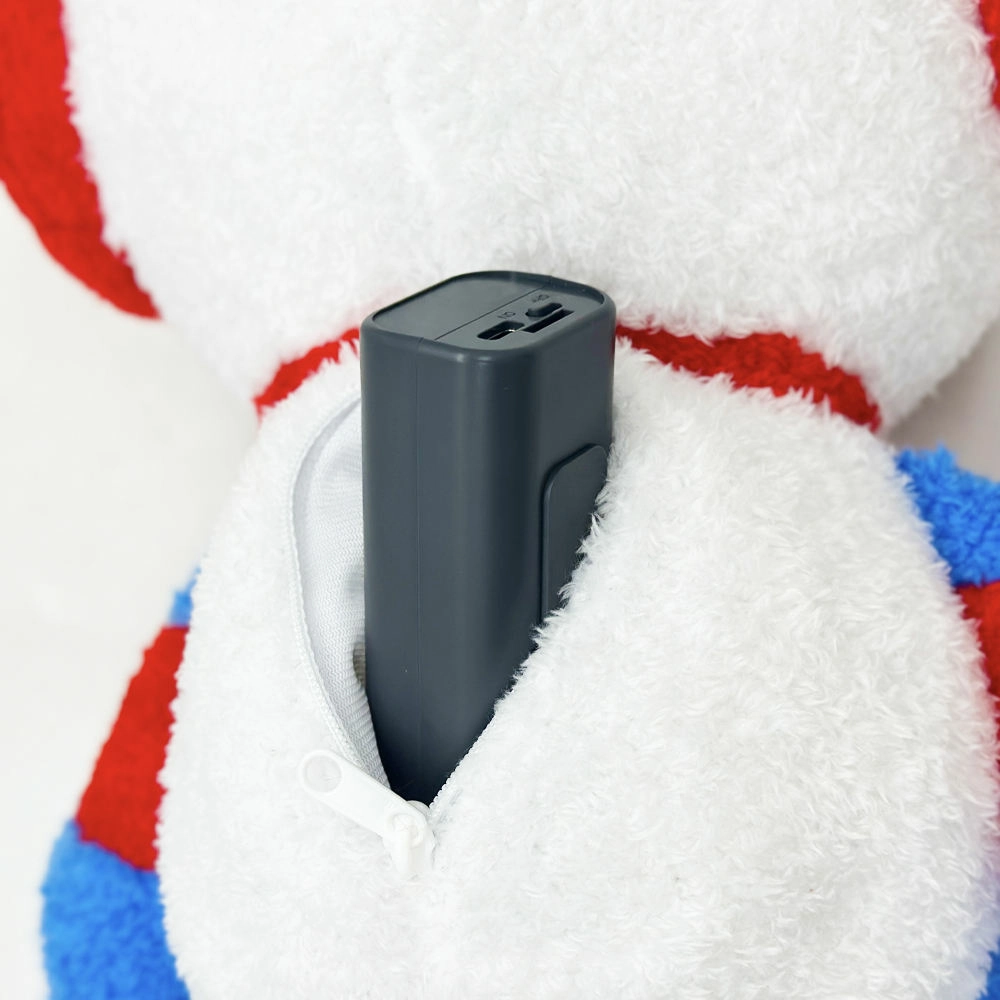
AI plush toys often have hard internal modules. If the module is too close to the surface, children may feel a hard edge when hugging the toy. If the compartment is weak, the module may become accessible after pulling, dropping, or repeated use.
For this reason, the internal structure matters as much as the outer fabric.
2. Battery and Electronic Module Safety
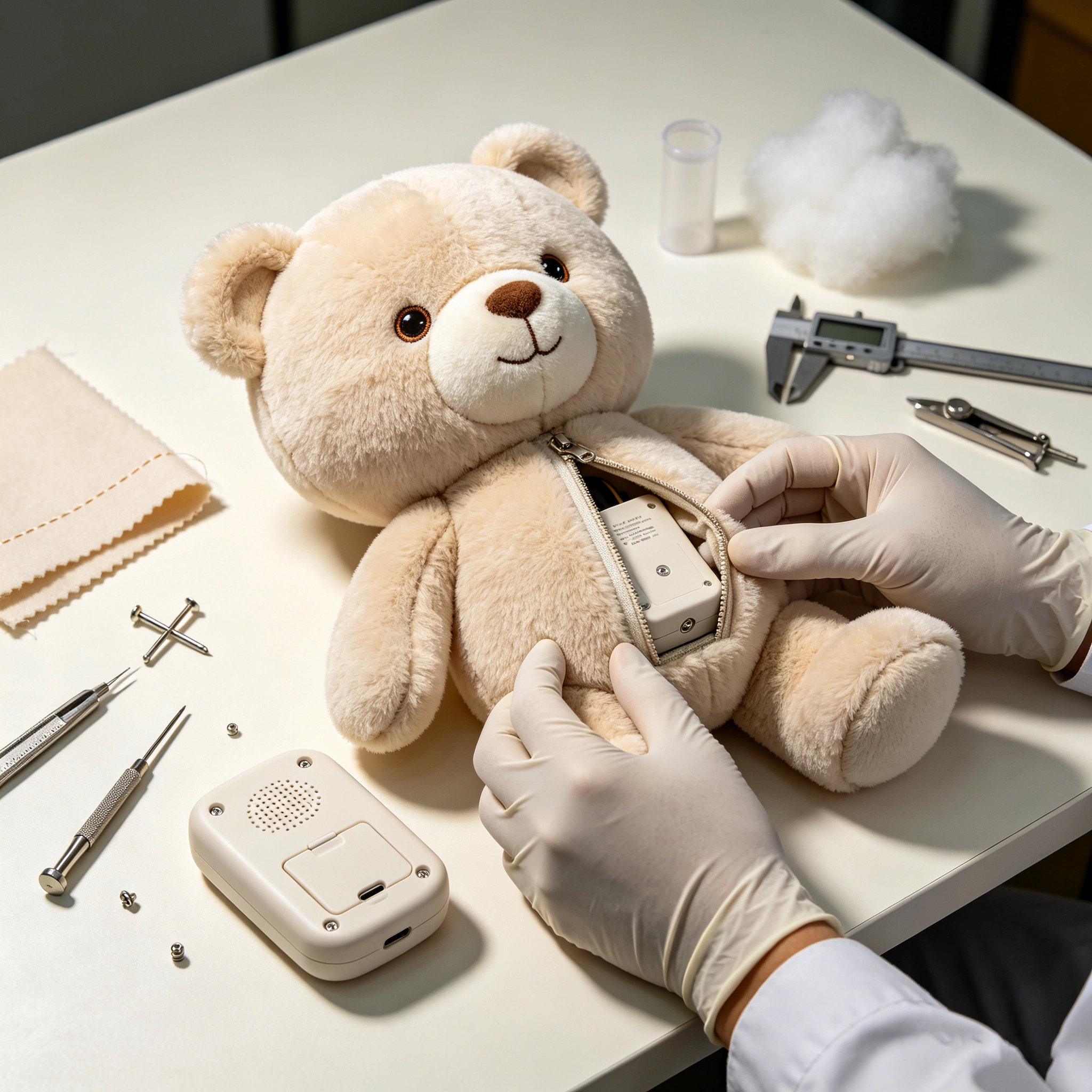
Battery access is one of the most important points in smart plush toys. A battery compartment should not open easily during play. Screws, covers, wires, and charging ports should be reviewed carefully.
CPSC toy safety guidance also notes that electrically operated toys have mandatory requirements under 16 CFR Part 1505. This is especially relevant when the plush toy includes a powered sound, light, recording, or communication module.
One common mistake we see is placing the electronic box inside the plush body without enough structural planning. The toy may look fine in photos, but the user experience is poor. The module moves around, the speaker sound becomes muffled, or the battery cover presses against the fabric.
For children’s plush projects, the electronic module should be planned together with the pattern design, not added at the end.
3. Voice Data and Child Privacy
Privacy is where AI plush toys become more sensitive than normal interactive stuffed animals.
If a toy collects, uses, stores, or shares personal information from children under 13 through an app, website, cloud service, microphone, or connected system, COPPA may apply. The FTC states that COPPA applies to child-directed online services and connected devices when they collect, use, or disclose personal information from children under 13.
Covered operators must provide clear privacy notices, obtain verifiable parental consent, protect children’s information, allow parents to review or delete information, and avoid collecting more information than needed.
This is not a small detail. A plush toy with a microphone may feel harmless, but children may speak names, school details, family information, emotions, or private routines. If that data is stored or processed poorly, the risk becomes serious.
4. AI Response Control
Traditional sound plush toys usually play fixed phrases. AI plush toys may generate flexible responses. That is the main selling point, but also the main concern.
Common Sense Media research on AI-enabled toys raised concerns around emotional attachment features, extensive data collection, and unreliable performance. It recommends no AI toys for children age 5 and under, and caution for children age 6 to 12.
For brands, this means AI content control should be tested through real child-like conversations, not only through short demo prompts. A toy may answer safely at first, then fail after repeated questions, unclear speech, or unusual role-play requests.
In many projects, the safest approach is to limit the AI function. A screen-free AI toy does not need to become an open-ended chatbot. It can be safer when it focuses on fixed story paths, parent-approved content, limited topics, and local processing where possible.
5. Washability and Daily Use
Regular plush toys can often be designed for hand washing or surface cleaning. AI plush toys are harder. The electronic module may need to be removable, but a removable module creates another safety challenge.
If the module is removable, the zipper or opening must be secure. If it is not removable, cleaning instructions must be realistic. A toy used by children may face saliva, spills, dust, and daily hugging. If the cleaning method is too limited, customers may complain after launch.
This is why washability should be discussed during sampling, not after packaging is printed.
Regular Plush Toys vs AI Plush Toys: Safety Comparison
| Safety Area | Regular Plush Toys | AI Plush Toys |
|---|---|---|
| Physical safety | Fabric, seams, filling, small parts, labels | All regular plush checks plus electronic structure |
| Battery risk | Usually not applicable | Battery cover, charging port, heat, wire safety |
| Sound control | Fixed sounds or squeakers | Speaker volume and AI-generated voice output |
| Privacy | Usually low risk | May involve microphones, apps, accounts, and cloud data |
| Compliance scope | ASTM F963, CPSIA, CPC, labeling | Toy safety plus privacy, wireless, and electronic review |
| Sampling difficulty | Moderate | Higher because plush, hardware, software, and data flow must align |
U.S. Compliance Points for AI Plush Toys
For the U.S. market, brands should not treat AI plush toys as simple gift plush items. If the product is intended for children, the compliance review should be more complete.
Important areas may include:
- ASTM F963-23: mandatory U.S. toy safety standard under 16 CFR Part 1250 Safety Standard for Toys.
- CPSIA: lead, phthalates, tracking labels, third-party testing, and children’s product certification.
- CPC: a Children’s Product Certificate must identify the product, applicable safety rules, manufacturer or importer, testing details, and CPSC-accepted lab information.
- Small parts rules: certain children’s products with small parts require small parts and choking hazard review.
- COPPA: relevant when online services, apps, IoT devices, or connected systems collect personal information from children under 13.
- FCC review: relevant when the toy includes Bluetooth, Wi-Fi, or other radio-frequency functions.
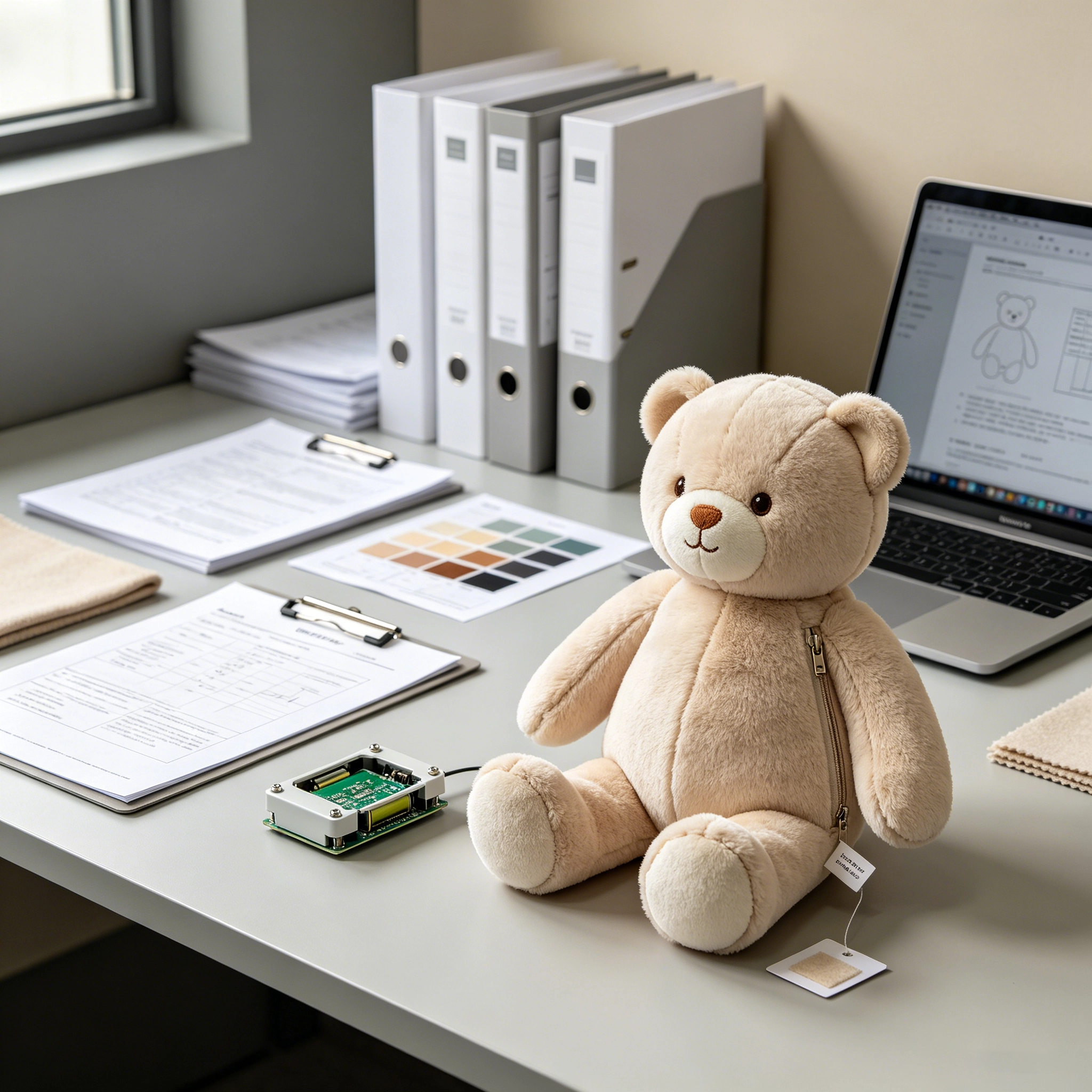
At Wehao Toys, we usually recommend confirming the target age, sales channel, electronic function, privacy flow, and testing scope before sample production. This avoids a common problem: developing a cute prototype first, then discovering that the compliance path is more difficult than expected.
When Are AI Plush Toys More Risky?
AI plush toys become more risky when they are designed as emotional companions instead of limited interactive toys.
Extra caution is needed when the product:
- Encourages children to treat the toy as a close friend
- Uses open-ended chatbot conversation
- Records or stores voice data
- Requires a child account or companion app
- Uses cloud-based AI processing
- Has weak parental controls
- Contains a non-removable battery module
- Targets toddlers or preschool children
- Gives advice, emotional support, or behavior guidance
Recent policy attention also shows that AI toys are becoming a serious regulatory topic. In April 2026, Congressman Blake Moore introduced the AI Children’s Toy Safety Act, which focused on artificial intelligence chatbots in children’s toys and childcare articles.
What We Usually Recommend Before Developing an AI Plush Toy
For most children’s plush projects, a safer custom plush toy development path starts with limits.
We usually recommend the following steps:
- Define the age grade first. A toy for ages 3+ is very different from a toy for ages 8+.
- Keep the AI function narrow. Storytelling, guided learning, or parent-approved content is easier to control than open chat.
- Review the data flow early. Decide whether the toy records, stores, uploads, or shares voice data.
- Plan the electronic module before pattern making. The plush shape must support the hardware safely.
- Test real use scenarios. Include hugging, dropping, pulling, repeated button pressing, and child-like speech.
- Confirm U.S. testing requirements before bulk production. Do not wait until the final sample is approved.
- Make parent controls clear. Parents should understand how to turn off recording, delete data, and control usage.
A well-developed smart plush toy should not rely on marketing words like “safe AI” or “child-friendly chatbot.” It should have real controls, clear documents, suitable testing, and a conservative product design.
Final Verdict: Are AI Plush Toys Safe for Children?
AI plush toys are not automatically unsafe, but they are much harder to make safe than regular stuffed animals.
A basic plush toy mainly needs strong material, secure stitching, safe filling, proper labeling, and age-appropriate design. An AI plush toy must also manage battery safety, electronic access, sound output, wireless compliance, data privacy, parental consent, and AI response behavior, especially when developed as part of a custom plush toys project.
For young children, especially children age 5 and under, buyers should be very cautious. For older children, AI plush toys may be more suitable when the function is limited, the content is controlled, parents stay involved, and the product passes proper safety and compliance review.
The safest direction is not to make a plush toy “as smart as possible.” The safer direction is to make it soft, controlled, transparent, testable, and appropriate for the child’s age.
FAQ About AI Plush Toys
Are AI plush toys safe for children?
AI plush toys can be safe only if the plush body, electronic module, battery access, AI response system, privacy design, and age grading are reviewed together. A soft outer fabric alone is not enough.
Are AI plush toys safe for children under 5?
Extra caution is recommended for children under 5. Young children may not understand that the toy is not a real friend, and they may share private information during play. According to Common Sense Media’s AI-enabled toy research, no AI toys are recommended for children age 5 and under.
What safety standards apply to AI plush toys in the USA?
If the product is sold as a children’s toy in the U.S., ASTM F963, CPSIA, CPC, small parts rules, lead limits, phthalate restrictions, tracking labels, and age grading may apply. If the toy includes wireless or connected features, FCC and privacy review may also be needed.
Do AI plush toys need COPPA compliance?
They may need COPPA compliance if the toy, app, website, cloud service, or connected system collects personal information from children under 13. This can include names, voice recordings, location data, photos, persistent identifiers, or other child-related personal data. Brands should review the FTC’s COPPA compliance guidance before launching connected AI toys for children.
Are screen-free AI toys safer than tablet-based toys?
Not always. Screen-free AI toys may reduce screen exposure, but they can still collect voice data, generate unsafe responses, or create emotional attachment. The risk depends on the design, controls, data handling, and age suitability.
What is the safest design approach for AI plush toys?
The safest approach is to limit the AI function, avoid open-ended chatbot behavior, use parent-approved content, secure the electronic module, protect children’s data, and complete safety testing before launch.