
1. Why a ’25 cm Plush Toy’ Can Mean Three Different Sizes Without Clear Measurement Points
Imagine ordering 2,000 units of a ’25 cm custom bunny plush’ for a retail gift box that measures 26 cm tall, only to discover upon prototype arrival that the bunny’s head and torso measure just 17 cm while its long upright ears account for the remaining 8 cm. In custom OEM manufacturing, ambiguous size callouts are the number-one cause of mismatched unit quotes, ill-fitting retail packaging, and pre-shipment inspection disputes.
Unlike injection-molded plastic figures or die-cast metal toys that hold rigid CAD dimensions within ±0.1 mm, stuffed animals are flexible three-dimensional textile shells filled with compressible polyester fiber. How a plush toy is posed (seated versus stretched flat), whether protruding appendages are included, and whether the inspector uses a rigid L-square ruler or a flexible tailor’s tape along the curved belly can shift the recorded measurement by 15% to 30%.
Because physical dimensions directly drive fabric yardage consumption and interior fiberfill volume—as detailed in our plush toy weight and stuffing density engineering guide—establishing unambiguous stuffed animal measurement points and plush toy dimensional tolerances before pattern drafting is essential for both cost accuracy and quality control.
2. How Do Buyers Define Measurement Points for a Plush Toy?
When buyers ask how do buyers define measurement points for a plush toy, professional tech packs never rely on a single ’20 cm’ number. Instead, they specify **Point-to-Point (P2P) straight-line axes** using three standardized views (Front, Side Profile, and Top-Down):
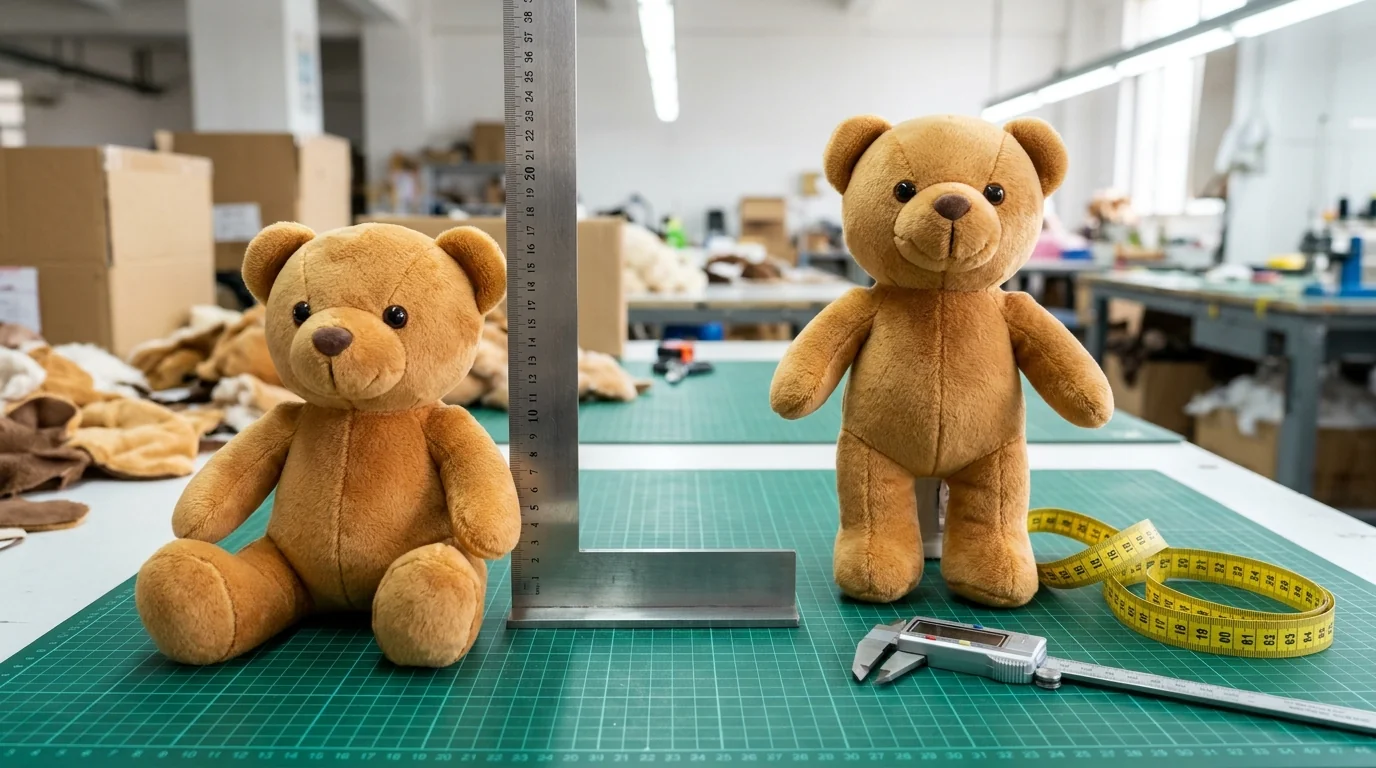
- Seated Height (Crown to Base / Rump): For seated bears, dogs, and mascots with dangling or forward-facing legs, measure vertically at a 90-degree angle from the flat table surface up to the top crown of the head (excluding ears/hats). This determines retail shelf clearance and window box height.
- Full Stretched Length (Head Crown to Toe Tip): For standing humanoid dolls, lying-down sleeping animals, or dangling plush keychains, lay the toy flat on an inspection table and measure the straight-line distance from the top of the head to the bottom of the heels.
- Maximum Width (Ear-to-Ear or Arm-to-Arm) & Depth (Snout to Tail): Measure the widest horizontal span across the cheeks or outstretched arms, and the front-to-back depth from the tip of the nose to the back of the rump or tail.
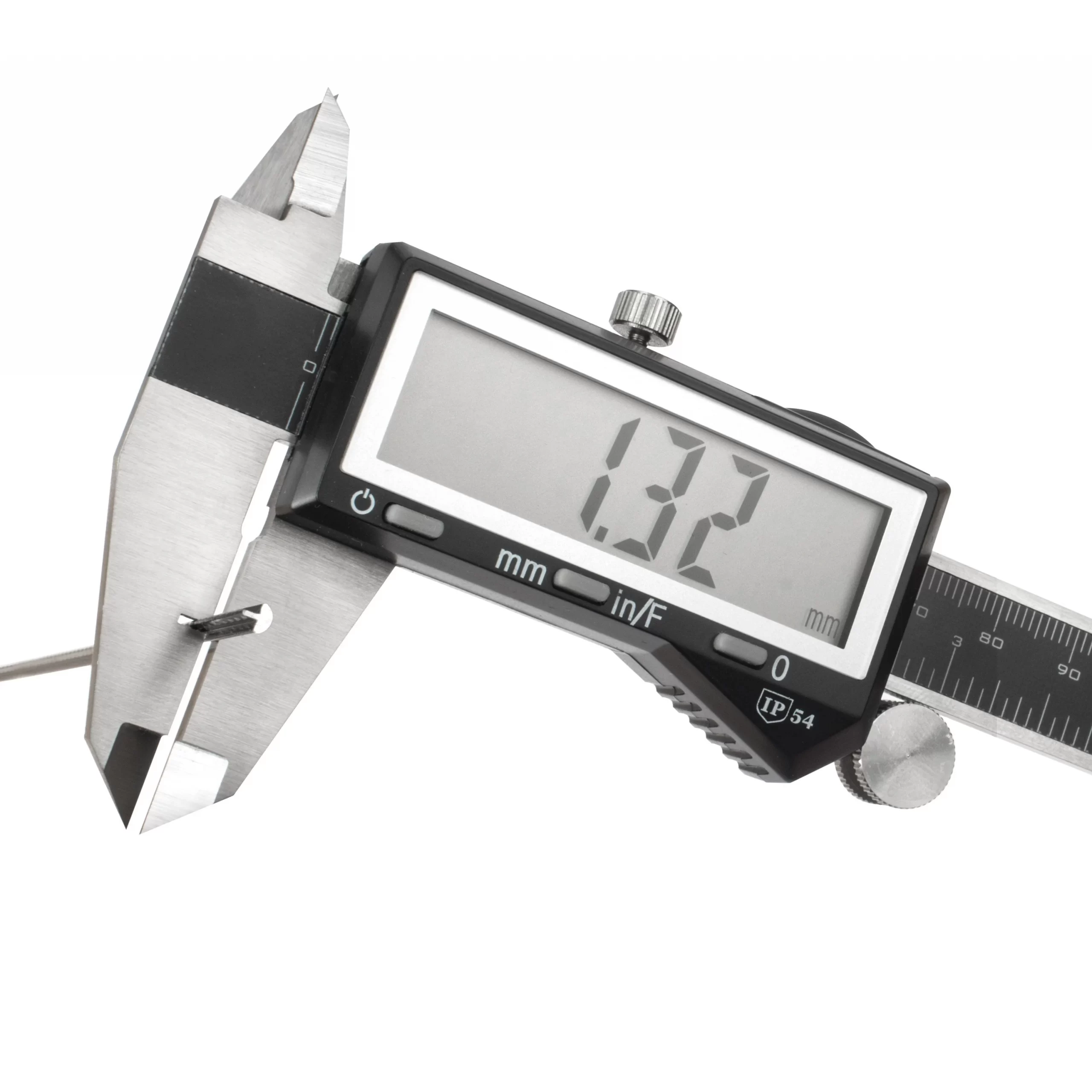
Always specify the **measuring instrument**: straight-line overall height, width, and depth must be measured between two parallel flat planes (using an L-square height gauge or large vernier calipers) without pressing down on the plush, whereas circumference (belly girth) is measured with a soft tailor’s tape resting lightly around the equator of the stuffed panel.
3. Should Plush Toy Height Include Ears, Horns, Hats, and Tails?
One of the most frequent questions during custom plush development and pattern setup is: should plush toy height include ears and other accessories? In B2B toy manufacturing, the standard rule is to **state both ‘Crown Height (Excluding Ears/Accessories)’ and ‘Total Tip-to-Base Height (Including Ears/Hats)’ as two separate numbers on the spec sheet**.
Why is separating these two figures so important? If you tell a factory to build a ’25 cm rabbit’ without excluding the ears, the pattern maker will build a tiny 16 cm body topped with 9 cm ears—resulting in a toy that looks dwarfed when displayed beside a 25 cm bear or cat in the same collection. Conversely, your packaging engineer needs the Total Tip-to-Base Height (including upright ears, unicorn horns, or pom-pom hats) so the inner blister tray or master shipping carton does not crush the top accessories.
4. How Should Dimensional Tolerances Be Agreed Before Plush Production?
Because plush shells are sewn from stretchy knitted textiles (such as crystal velboa or 4-way stretch spandex minky) and stuffed by hand or pneumatic blowing nozzles, two toys cut from the exact same laser die will naturally vary by a few millimeters depending on operator seam tension and stuffing distribution. When buyers ask how should dimensional tolerances be agreed before plush production, the industry-standard tolerance matrix below provides a fair, verifiable benchmark:
| Plush Size Category | Nominal Target Size | Standard Linear Tolerance (±) | Net Stuffed Weight Tolerance (±) |
|---|---|---|---|
| Mini Plush & Keychains | 8 cm – 12 cm (3″ – 5″) | ± 5 mm (± 0.2 in) | ± 3 g to 5 g |
| Small – Medium Core Plush | 15 cm – 25 cm (6″ – 10″) | ± 8 mm to 10 mm (approx. ± 4%–5%) | ± 5% of Golden Sample gram weight |
| Large Hugger Plush | 30 cm – 50 cm (12″ – 20″) | ± 12 mm to 20 mm (approx. ± 4%–5%) | ± 5% of Golden Sample gram weight |
| Jumbo Display & Pillows | 60 cm – 100 cm+ (24″ – 40″+) | ± 25 mm to 35 mm (approx. ± 5%) | ± 5% to 7% of Golden Sample weight |
During third-party pre-shipment inspections under ANSI/ASQ Z1.4 and ISO 2859-1 AQL sampling procedures, any unit that deviates beyond the agreed linear or weight tolerance is logged as a Major or Minor workmanship defect. Furthermore, for infant toys and small accessories, dimensional consistency directly impacts safety compliance under plush toy safety standards and compliance: a miniature plush accessory or pom-pom that shrinks by 6 mm during production could accidentally slip inside the small-parts choke test cylinder defined by U.S. CPSC and ASTM F963 safety rules and European EN 71-1 mechanical safety standards.
5. Frequently Asked Questions (FAQ)
Q: Why did our plush sample measure 24 cm at the factory but only 22 cm when unpacked at our office?
A: International courier packages are tightly taped or vacuum-sealed for air transit, which temporarily compresses the hollow polyester fiberfill along the vertical axis. Gently kneading the torso and allowing the sample to sit unpacked for 24 hours restores its full 24 cm loft.
Q: How do you keep a multi-character plush series looking the same size when the animals have different shapes?
A: Instead of fixing an identical total height (which makes a long-necked giraffe look tiny next to a wide bear), specify a unified ‘Eye-Level / Head Width and Torso Volume’ across all characters, allowing ears, horns, or necks to extend naturally above the common head line.
Q: Does four-way stretch mochi minky require wider dimensional tolerances than standard velboa?
A: Yes, because spandex-blend mochi minky stretches significantly in all directions depending on how firmly the operator stuffs the shell, buyers typically pair a ±5% linear dimension tolerance with a strict net gram weight target so the stuffing machine feeds the exact same fiber mass into every piece.
Q: What is the difference between paper pattern dimensions and finished stuffed plush dimensions?
A: A flat 2D fabric pattern must account for 5 mm seam allowances plus three-dimensional gusset curvature when stuffed into a sphere or cylinder. Consequently, a finished 20 cm round plush ball actually requires flat pattern panels measuring roughly 26 to 28 cm in arc length.
Q: How should we document approved dimensions on our Golden Sample?
A: Include a photographed Diagram of Measurement (DOM) directly on the signed Golden Sample PDF sheet with red dimension arrows showing exact Crown Height, Total Ear Height, Face Width, Belly Depth, and Net Gram Weight.
6. Lock In Precise Plush Sizing and Pattern Engineering With Wehao Toys
Need Accurate Pattern Scaling and Consistent Bulk Sizing for Your Plush Line? Clear point-to-point measurement diagrams and controlled stuffing gram weights ensure your custom plush toys fit their retail packaging and look uniform across every production batch. Wehao Toys provides complete technical specification sheets, calibrated L-square prototype verification, and strict inline dimensional QC. Contact Wehao Toys for a Custom Plush Toy Project today to review your character dimensions and start precision sampling.