
1. The Logistics Payoff vs. The Rebound Risk of Stuffed Animal Vacuum Packaging
In international B2B toy logistics, heat-sealed vacuum compression is the single most effective method for slashing ocean and air freight expenses—reducing master carton volume (CBM) by 60% to 75% on medium and large items like custom plush pillows and home decor cushions. Yet many brands hesitate to approve stuffed animal vacuum packaging out of a valid commercial fear: what if the toys arrive at the destination warehouse or customer’s doorstep permanently flattened, wrinkled, or lopsided?
Compressed plush shipping damage is almost never caused by vacuum sealing itself; rather, it happens when factories vacuum-pack unsuitable materials (such as brittle foam inserts, long crushed pile, or low-grade recycled fiberfill) or apply excessive negative pressure without running a pre-shipment rebound test. By engineering the internal fiberfill for mechanical memory and conducting a standardized vacuum packed plush toy shape recovery test before bulk packing, brands can capture massive freight savings without sacrificing retail shelf presentation.
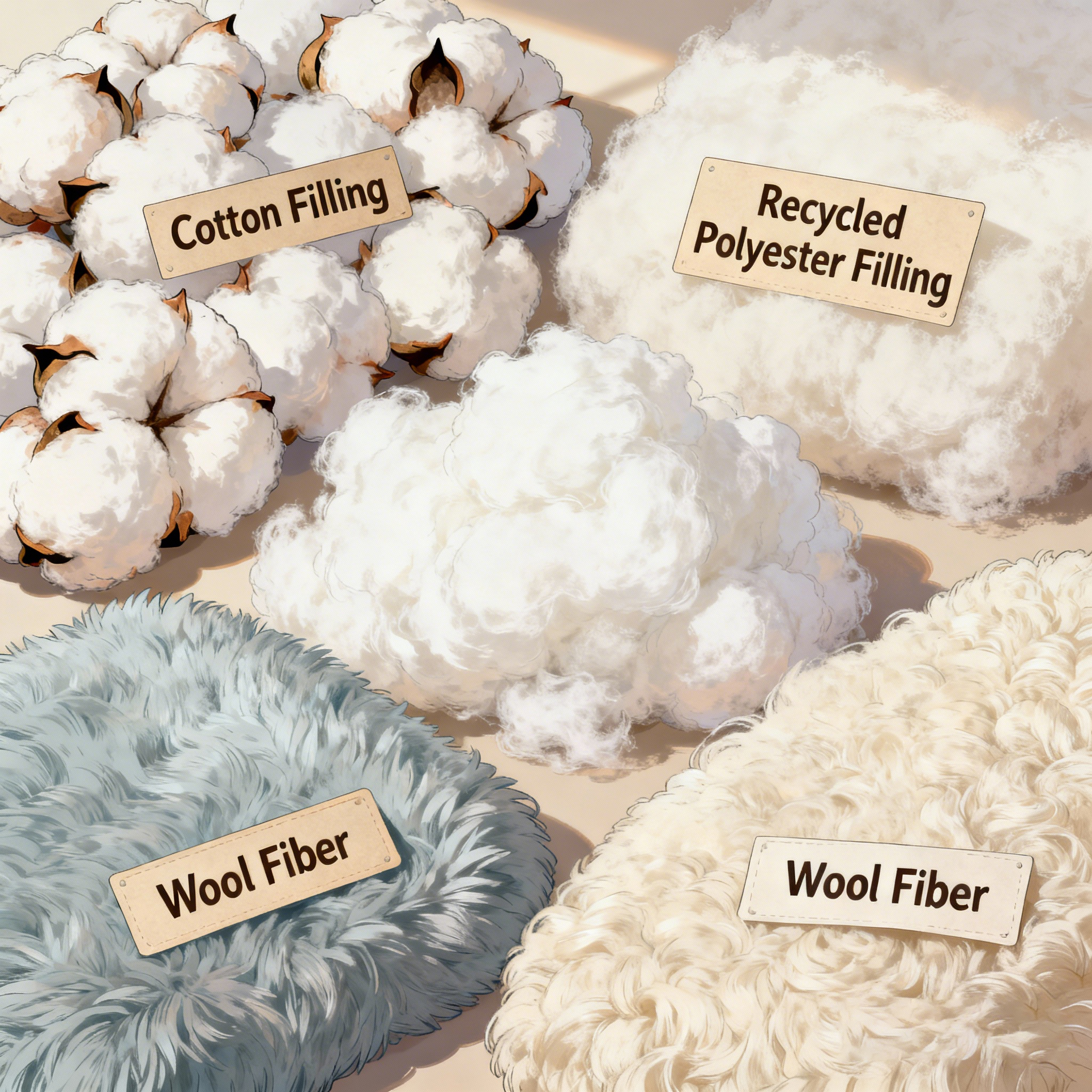
As explained in our plush toy weight and stuffing guide, plush stuffing rebound depends on the microscopic spiral crimp and silicone coating of the interior polyester fibers. Specifying 100% virgin 7D or 15D three-dimensional conjugated hollow siliconized polyester fiber ensures that each fiber acts like a tiny coiled spring that pushes the shell back out as soon as air re-enters the bag.
2. Which Plush Designs May Be Unsuitable for Vacuum Packaging?
Not every stuffed animal should be put inside a chamber vacuum sealer. When procurement teams ask which plush designs may be unsuitable for vacuum packaging, OEM engineers screen out products containing any of the following five structural elements:
- 1. Internal EVA Foam, Cardboard, or Flat Foot Inserts: Standing anime dolls or mascots that use flat EVA foam soles or cardboard base plates to stand upright will suffer permanent crease folds across the footplate under vacuum pressure.
- 2. Internal Wire Armatures, Plastic Skeletons, or Sound/LED Modules: Posable wire frames can bend or puncture the outer fabric shell under heavy compression, while plastic battery boxes and pull-string vibration housings can crack or press permanently into the plush surface.
- 3. Large 3D Plastic Safety Eyes or Rigid Molded Snouts: While small 8–12 mm plastic eyes can survive light compression if folded inward carefully, oversized 20+ mm dome eyes or hard flocked noses can scratch or indent adjacent fabric panels when vacuum-flattened.
- 4. High-Pile Faux Fur (15+ mm) & Stiff Felt Appliqués: Ultra-long woven faux fur, stiff non-woven felt hats, or structured tulle skirts develop deep heat-set fold creases during multi-week sea transit in warm containers.
- 5. Pre-Assembled Rigid Retail Window Boxes: A plush toy already placed inside a cardboard display box cannot be vacuum-sealed; instead, vacuum-pack the plush in polybags and ship the flat-folded retail boxes in separate master cartons for destination kitting.
3. Step-by-Step Protocol: How Do I Test Plush Toy Shape Recovery After Vacuum Packing?
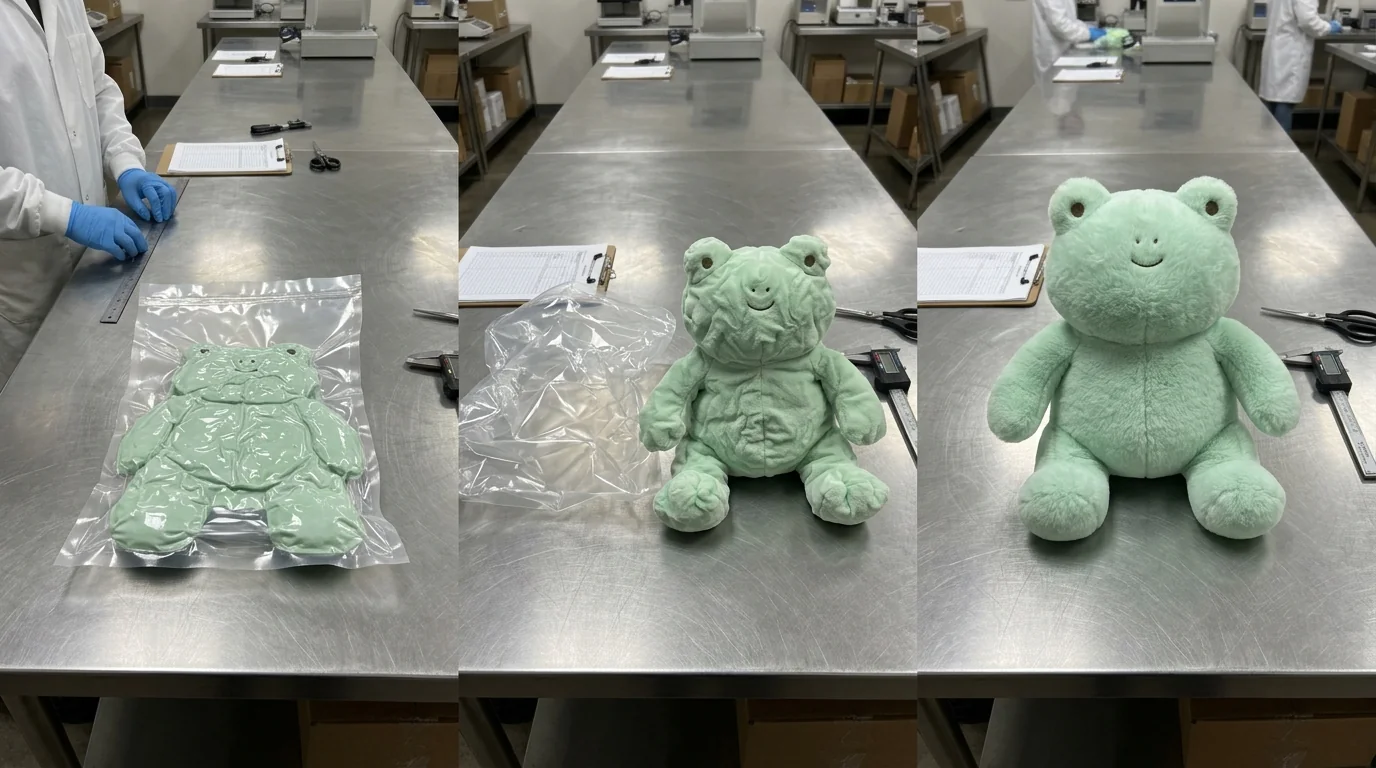
Before authorizing bulk vacuum compression on a new SKU during custom plush development and packaging setup, require the factory QC lab to perform a **72-Hour Accelerated Compression & Rebound Test** on three pre-production units:
| Test Stage | Procedure & Parameters | Target Passing Benchmark | Failure Indicator (Do Not Vacuum) |
|---|---|---|---|
| 1. Orientation & Sealing | Fold limbs/ears flat toward belly; seal in 0.08mm PA/PE co-extruded bag at 60%–70% volume reduction (avoid 90% ‘rock-hard’ over-vacuum) | Uniform flat pancake profile; face embroidery kept flat without folding across eyes | Eye embroidery folded in half; sharp plastic nose pressing against fabric |
| 2. 72-Hour Hold & Heat Simulation | Store compressed bags under a 15 kg carton load at 35°C–40°C for 72 hours to simulate ocean container stacking | Zero bag air leakage (no ‘leakers’ expanding prematurely in carton) | Pinholes in polybag or seam stress marks along gussets |
| 3. 15-Minute Initial Pop | Cut bag open, allow passive air intake plus 30 seconds of gentle manual patting/kneading | Regains ≥ 85% of original Golden Sample height and width within 15 minutes | Stuffing remains matted in a hard lump inside the torso |
| 4. 24-to-48 Hour Full Recovery | Let plush rest at room temperature (optional 5-minute low-heat steamer pass for retail floor prep) | Regains ≥ 95%–98% of Golden Sample loft, symmetry, and smooth pile | Permanent deep fold lines on face or crooked neck posture |
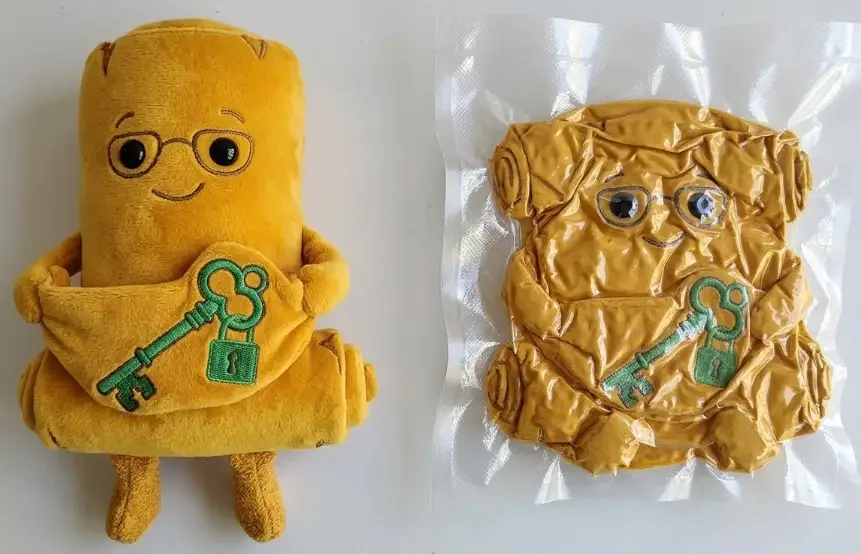
Notice the critical engineering rule in Stage 1: **never over-compress plush to 85%–90% ‘brick-hard’ vacuum levels**. Compressing a plush toy by 60% to 65% of its volume achieves nearly the same freight savings while leaving enough microscopic air cushion between fibers to prevent permanent crease setting during a 35-day ocean voyage.
4. What Should Buyers Inspect After Unpacking Compressed Plush Toys?
When your shipment arrives at your 3PL warehouse or during pre-shipment AQL inspection, follow a targeted unpacking checklist. For buyers asking what should buyers inspect after unpacking compressed plush toys, focus on four critical points:
First, check **Vacuum Bag Seal Integrity (‘Leaker Rate’)**: if more than 2% of bags in a master carton have lost vacuum pressure due to micro-punctures from hangtag pins, those expanded toys can burst the outer corrugated carton; always tuck paper hangtags inside a protective inner sleeve or attach them with soft cotton string rather than sharp plastic swift-tacks when vacuum packing. Second, inspect **Facial Embroidery & Appliqué Flatness**: confirm that satin-stitched eyes and mouths have not buckled. Third, verify **Neck & Limb Fiber Distribution**: gently massage fiberfill back into narrow neck and arm channels. Fourth, confirm that the outer vacuum polybag carries mandatory child suffocation warnings and meets thickness requirements under plush toy safety standards and compliance, U.S. CPSC and ASTM F963 packaging rules, and European EN 71-1 plastic film thickness regulations.
5. Frequently Asked Questions (FAQ)
Q: How long can plush toys stay vacuum-packed in storage before losing their ability to rebound?
A: When stuffed with 100% virgin hollow siliconized polyester fiber and compressed to a moderate 60%–65% ratio, plush toys can remain vacuum-sealed for 3 to 6 months (covering ocean transit and warehouse staging) and still recover 95%+ of their loft. For storage exceeding 6 months, unpack the bags or use non-compressed storage.
Q: How can DTC e-commerce brands help end customers fluff up a vacuum-packed plush toy at home?
A: Include a friendly illustrated ‘Wake Up Your Plush!’ instruction card inside the outer mailer telling customers to open the vacuum seal, gently pat and massage the plush for 1 minute, and let it rest for 24 hours (or tumble in a dryer on air-fluff/no-heat for 10 minutes) to reach maximum cloud-like softness.
Q: Why do some vacuum bags slowly inflate inside the shipping carton after a few days?
A: Standard thin PE (polyethylene) polybags are gas-permeable and easily punctured by sharp paper hangtag corners. Vacuum-packed plush requires co-extruded PA/PE (nylon-polyethylene) barrier bags (0.07 mm to 0.09 mm thick) and rounded hangtag corners covered with a small protective foam pad.
Q: Which shell fabrics recover best from vacuum compression wrinkles?
A: Four-way stretch spandex minky (mochi plush) and short-pile 1.5 mm crystal velboa have the highest elastic recovery and show virtually zero wrinkles within hours of unpacking, whereas woven-back long faux fur and stiff felt require light steaming or brushing.
Q: Can we vacuum-pack multiple small plush toys together inside one large master bag?
A: For B2B retail store replenishment where staff unpack the goods before shelf display, bulk-vacuuming 5 to 10 toys per master liner bag saves packaging film cost. For Amazon FBA or DTC orders, each toy must be individually vacuum-sealed with its own barcode and suffocation warning label.
6. Engineer High-Rebound Vacuum-Packed Plush With Wehao Toys
Want to Cut Your Plush Shipping Volume by 65% Without Compromising Shelf Quality? Combining high-resilience virgin siliconized fiberfill, puncture-resistant PA/PE barrier bags, and pre-shipment 72-hour compression rebound testing lets you ship smarter and protect your retail margins. Wehao Toys provides complete vacuum packaging validation across custom plush pillows, huggers, and gift lines. Contact Wehao Toys for a Custom Plush Toy Project today to test your plush design’s compression recovery and optimize your freight budget.