
Quick Answer
For a retail plush toy, a hang tag should normally help identify the brand, product, SKU and retail barcode while providing any useful customer-facing information that fits the sales channel. However, buyers should not assume that every legally required label can simply be moved onto a removable hang tag.
The safest approach is to plan the hang tag together with the sewn label, packaging and target-market compliance requirements. Before bulk production, confirm the final artwork, barcode, SKU, languages, attachment position and which information must remain permanently attached to the toy.
Hang Tags Are a Retail Layer, Not the Permanent Compliance Label
A plush toy hang tag, sometimes called a swing tag, is normally removable. This makes it useful for branding, barcodes, character information and retail presentation, but it also creates an important compliance limitation. Information that must remain permanently associated with the product should not automatically be assigned to the hang tag simply because there is more printing space available.
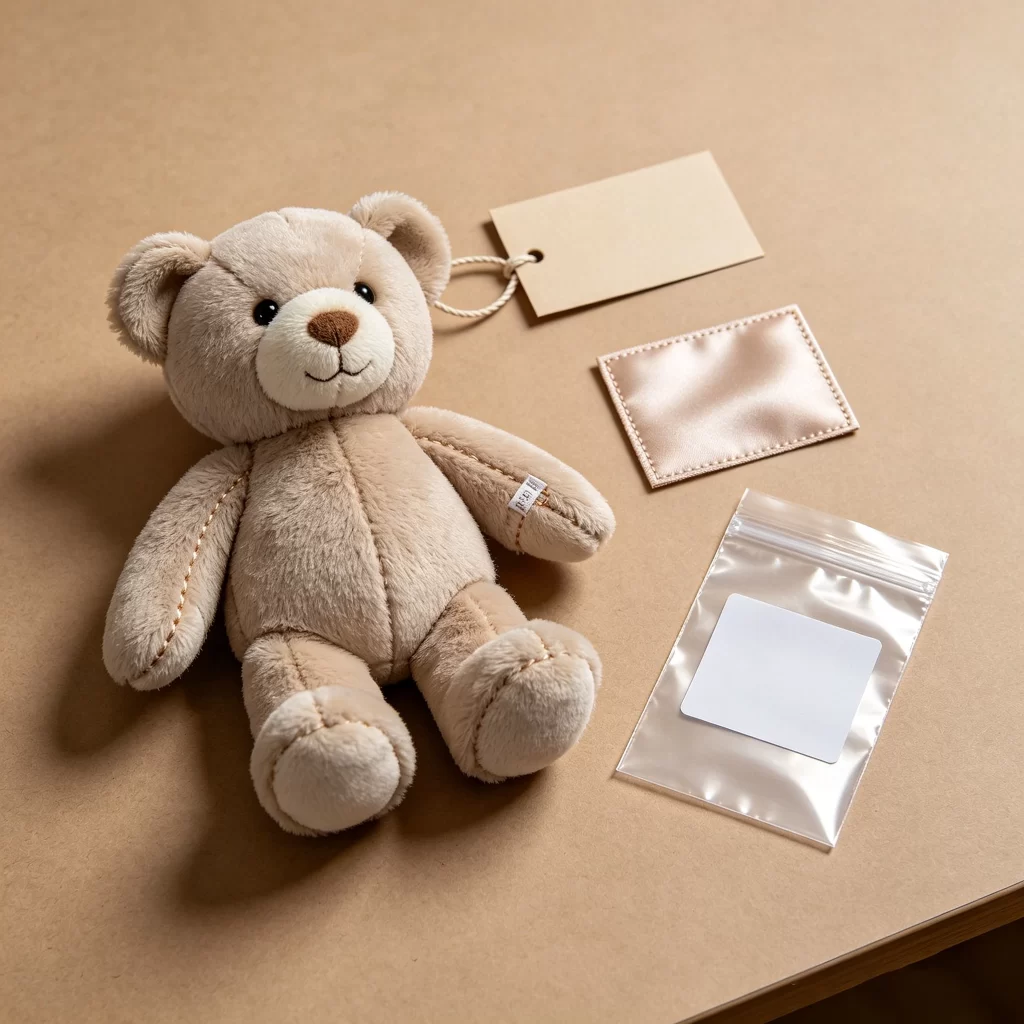
This distinction is particularly important for children’s plush toys sold in the United States. CPSC tracking-label rules require identifying information to be permanently marked on the children’s product and its packaging, to the extent practicable. CPSC specifically states that hangtags are not considered permanent tracking labels for textile-type children’s products.
That does not mean compliance information can never appear on product hang tags. It means the retail tag and permanent product-label system should be planned separately. In most plush toy projects, we recommend deciding what belongs on the sewn label first and then using the hang tag for information that benefits from visibility before purchase.
What Information Should Be on Plush Toy Hang Tags?
There is no universal hang tag layout that works for every plush toy. A museum plush, collectible character, supermarket teddy bear and promotional mascot may all need different information. The useful question is therefore not “How much can we fit on the tag?” but “What does the shopper, retailer and inventory system actually need?”
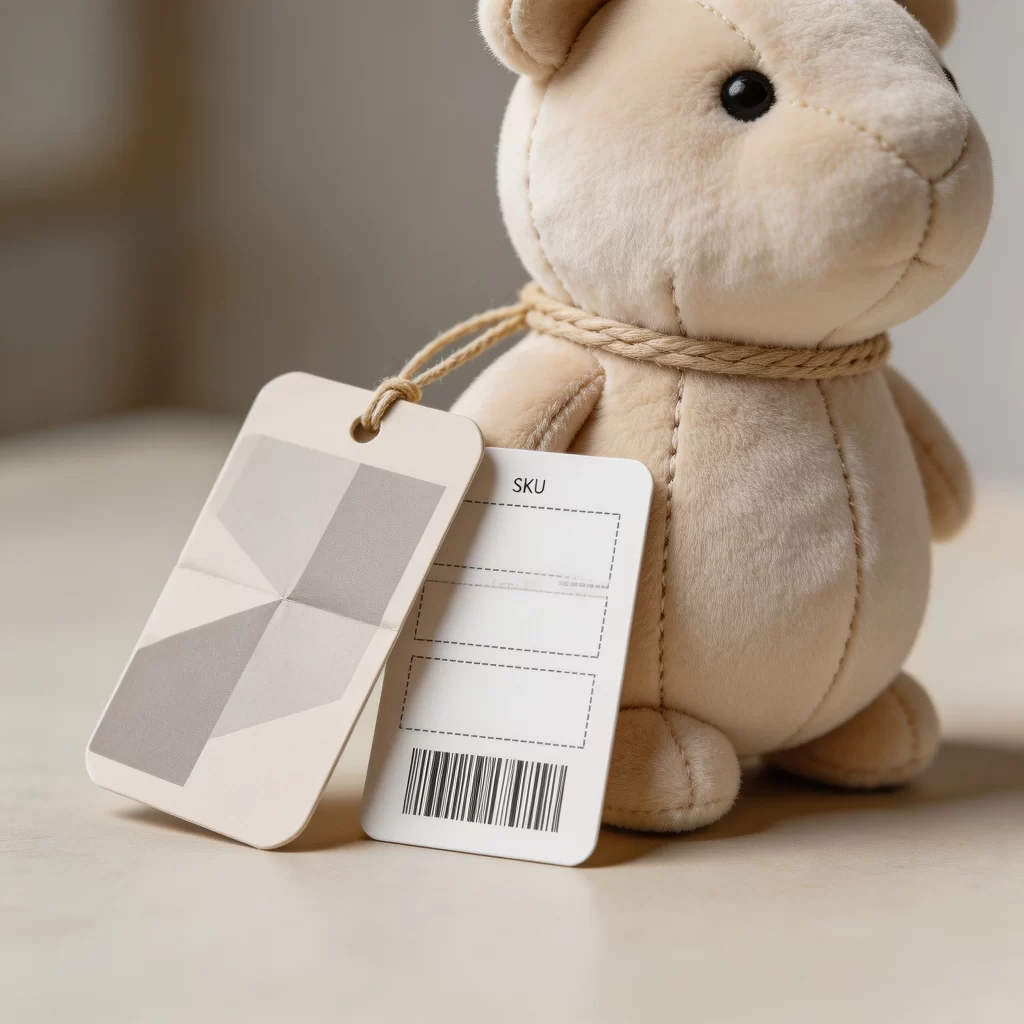
A practical retail hang tag may include:
| Information | Typical Purpose | Priority |
|---|---|---|
| Brand name or logo | Brand identification | High |
| Product or character name | Customer identification | High |
| SKU / style number | Inventory control | High |
| UPC / EAN / GTIN barcode | Retail POS scanning | High for retail |
| Collection or series name | Assortment management | Optional |
| Website or QR code | Product or brand information | Optional |
| Short character story | Brand storytelling | Optional |
| Care reminder | Consumer reference | Conditional |
| Age information | Product communication | Conditional |
| Required warning | Compliance support where applicable | Market-dependent |
| Sustainability claim | Marketing | Only when substantiated |
A good custom hang tag rarely needs all of these elements. Retail buyers should first reserve space for operational information, then decide how much remaining space is worth using for brand storytelling. Overloading a small tag with marketing text, care instructions, warnings and five different icons often makes the important information harder to find.
Separate Retail Information From Compliance Information
One of the most common mistakes is treating a hang tag as the complete legal label for every sales market. In reality, U.S. and European requirements depend on the product, intended age group, distribution location and information already placed on the toy or packaging. The correct label system therefore needs to be reviewed as a whole rather than designed around the paper tag alone.
For EU toy sales in 2026, current Toy Safety Directive requirements still require manufacturers to provide product identification and manufacturer information, while importers also have identification obligations. CE marking may appear on the toy, an affixed label or the packaging depending on the applicable conditions, and required warnings and safety information must also be properly presented. The newer EU Toy Safety Regulation 2025/2509 will replace the current directive from August 1, 2030, so brands planning long-running product programs should also keep future artwork changes in mind.
The United States can also involve state-level requirements in addition to federal toy rules. Pennsylvania, for example, requires stuffed toys offered in the state to carry a securely affixed tag or label showing the required material statement and Pennsylvania registration number. Retail buyers distributing nationally should therefore confirm destination-specific requirements rather than assuming one attractive swing tag automatically solves every labeling issue.
Give the Barcode Enough Space to Work
For plush toys entering traditional retail, the barcode is often one of the most operationally important parts of the hang tag. GS1 uses GTINs to uniquely identify trade items, and EAN/UPC barcodes remain widely used at retail point of sale. The barcode should therefore be treated as a functional printing element, not a graphic decoration that can simply be resized until it fits the design.
Before approving artwork, the retailer should confirm the correct GTIN for each sellable SKU and whether the product needs UPC-A, EAN-13 or another retailer-approved format. The artwork should leave adequate quiet space around the barcode, maintain sufficient contrast and avoid printing it across a fold, hole, metallic foil or heavily textured background. A visually attractive tag that scans poorly creates a warehouse and checkout problem rather than a branding advantage.
Different colors, sizes or character versions may also require separate product identifiers. Buyers should therefore avoid sending a “sample barcode” that later becomes accidentally locked into production artwork. The final barcode data should be treated as controlled SKU information and checked again on the physical printed sample.
Decide Tag Size, Format and Attachment Before Production
Custom hang tags can be single cards, folded cards, multi-panel tags or die-cut shapes. Paper stock, coating, matte or gloss finish, foil, embossing and string choice can all change the presentation. However, adding more finishing processes also adds print preparation, supplier coordination and sometimes separate production minimums.
Size should be considered relative to the plush rather than in isolation. A large tag can overwhelm a 10 cm mini plush, while a very small tag may leave too little room for a readable barcode or multilingual information. Folded tags are useful when more information is genuinely required, but they may be unnecessary for a simple promotional plush with one SKU and minimal retail content.
Attachment deserves the same attention. Plastic loops, strings, paper cords and ribbons all create different costs and visual effects. The chosen attachment point should not block the plush face, distort a thin ear or pull against a weak seam when the tag hangs during transport and shelf display.
Approve the Hang Tag With the Plush Sample
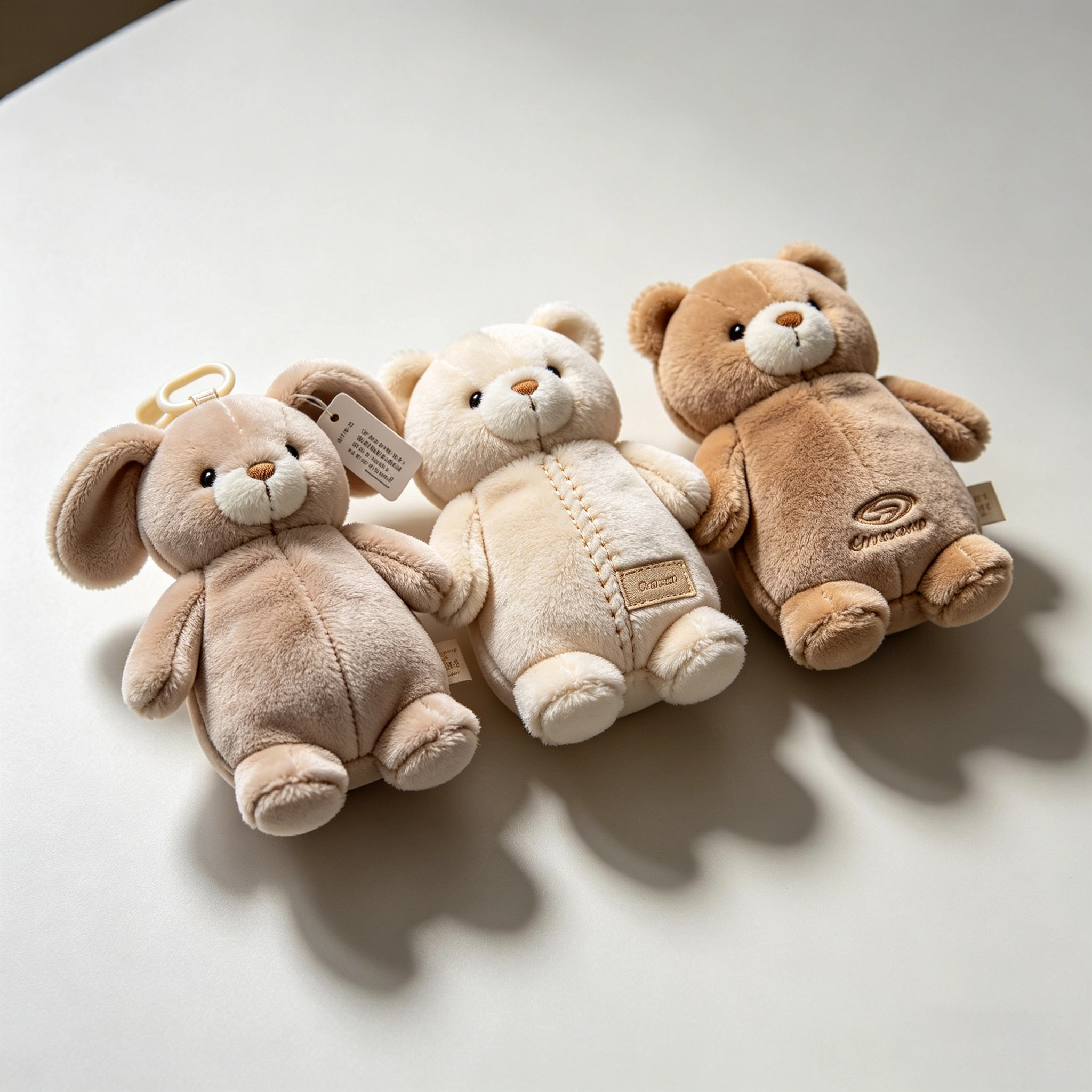
Hang tag artwork should not be approved only as a PDF on a computer screen. The physical relationship between the toy and tag matters, including scale, hanging angle, attachment point, barcode readability and how much of the character remains visible. We usually recommend reviewing at least one physical tag or production-equivalent print together with the approved plush sample before mass production.
In our sampling experience, problems often appear only after the tag is attached. A hole may be too close to the card edge, a long tag may cover the character’s face, or the selected string may make the tag rotate backwards on the shelf. None of these problems is difficult to correct during sampling, but they become far more inconvenient once thousands of printed tags have already been produced.
The same review should cover the packaging format. If the plush will sit inside a retail box, display tray or protective bag, check whether the hang tag remains visible, becomes trapped inside the package or needs a different attachment orientation.
Control Shared Artwork and SKU-Specific Information
A collection of six plush characters does not always need six completely different hang tag designs. Brand graphics, care information and general collection artwork can sometimes remain shared while SKU, character name and barcode information changes by version. This reduces unnecessary artwork variation and makes future reorders easier to manage.
However, shared artwork only works when the variable information is clearly controlled. Buyers should provide an SKU matrix showing which barcode, product name, character, color or language belongs to each design. File names such as “final.pdf,” “final2.pdf” and “final-new.pdf” are a surprisingly poor production-control system.
At Wehao Toys, we usually recommend freezing hang tag artwork as part of the final pre-production specification rather than handling it as a loose marketing file. Once artwork, dimensions, material, finishing and attachment are approved, those details should stay linked to the corresponding plush SKU for the bulk order and future repeat orders.
Common Hang Tag Mistakes That Create Production Problems
Many hang tag problems are not printing defects. They start earlier, when the information has not been finalized.
Common examples include:
- sending the barcode after printing has already been arranged;
- using the same barcode across different retail SKUs;
- putting permanent tracking information only on a removable tag;
- approving artwork without confirming destination-market languages;
- making the tag too small for readable information;
- placing the attachment hole through important artwork;
- attaching a heavy tag to a thin plush seam;
- adding unsupported environmental or material claims;
- changing product names after barcode and packaging files are approved;
- treating the tag as independent from the sewn label and retail packaging.
The cost of the paper tag itself is often small compared with the cost of correcting a labeling mistake across a completed production run. This is why hang tag approval should happen before bulk material and packaging preparation is locked.
A Pre-Production Hang Tag Approval Checklist
Before releasing custom hang tags for production, retail buyers should confirm:
- final brand artwork;
- final product or character name;
- SKU or style number;
- correct GTIN / UPC / EAN data;
- target sales countries;
- required languages;
- compliance information placement;
- sewn-label information;
- tag dimensions;
- single, folded or multi-card structure;
- paper stock and finish;
- string or fastener type;
- attachment position;
- barcode scan test;
- packaging compatibility;
- quantity by SKU;
- spare-tag requirements;
- final approved artwork version.
The best time to complete this check is before bulk production, not when the finished plush toys are waiting for tags. When the hang tag, sewn label, plush sample and packaging are approved as one retail system, there is much less room for last-minute artwork changes.
Key Takeaways
Hang tags are small components, but they connect branding, retail operations and product information. For most retail plush projects, the essential starting points are the brand identity, product or SKU identification and a correctly assigned retail barcode.
The more important rule is to understand what the hang tag should not replace. Permanent product identification, tracking information and market-specific compliance requirements may need to remain on the toy, packaging or another compliant label.
Retail buyers should therefore finalize swing tags during sampling and approve them as part of the complete product specification. That approach is usually more reliable than designing the tag after the plush toy itself is already ready for production.
FAQ About Plush Toy Hang Tags
Can one hang tag design be used for several plush toy SKUs?
Yes. Shared brand artwork can often be used across a collection while variable information such as character name, SKU and barcode changes. Create a clear SKU matrix so the production team can match every version correctly.
Should the retail price be printed directly on the hang tag?
Not necessarily. If several retailers or countries will sell the same plush toy at different prices, a dedicated sticker area is usually more flexible than printing a fixed price into the main artwork.
Can a QR code replace the UPC or EAN barcode?
Do not assume so. GS1 is developing broader retail use of 2D barcodes, but traditional EAN/UPC symbols are still widely used at point of sale, and retailer systems differ. Confirm the retailer’s barcode requirement before removing a conventional POS barcode.
How many languages should an EU plush toy hang tag include?
There is no single language count for the whole EU. Required warnings, instructions and safety information need to meet the language requirements of the Member State where the toy is sold, so the planned countries should be identified before artwork is printed.
Should we print extra swing tags with the first production run?
It can be useful. Spare tags can support replacement of damaged tags, photography samples or small reorder needs, but the appropriate quantity depends on the printing method and supplier minimum.
Can the hang tag be attached through a plush toy’s ear?
Sometimes, but the construction should be checked first. Thin ears, long-pile fabric and visible character features may make another attachment point cleaner and less likely to distort the product.
Finalize Your Hang Tag Before Bulk Production
If you are preparing a retail plush collection, send the plush artwork, target market, SKU list, barcode requirements and preferred packaging together rather than developing each item separately. The complete label and packaging system can then be reviewed during sampling, before printed materials and bulk production are released.
Contact Wehao Toys for a Custom Plush Toy Project